Four years ago today an EF-4 tornado ripped across Western Kentucky, claiming lives and buildings in its wake

– 3 min read


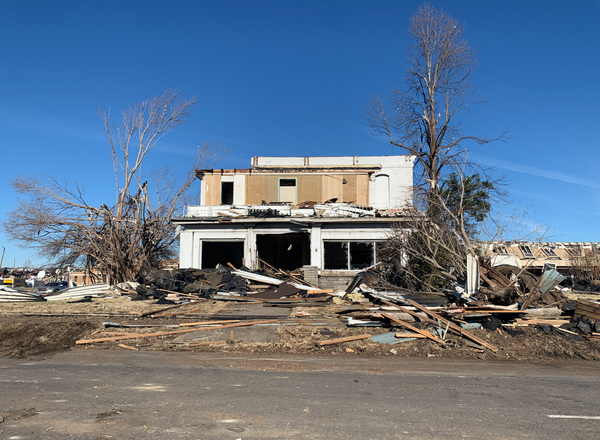
December 10th marks a dark day for many communities in Western Kentucky.
"I'm Shay McAlister, and this is Shay Informed: an independent, ad-free platform dedicated to honest journalism with compassion and clarity.
Are you new here? Sign up for the free newsletter or subscribe to support our mission.
December 10th is the day an overnight tornado killed 57 people across Western Kentucky. The trail of destruction included thousands of homes, businesses, and churches ripped apart and left for scrap. The process to rebuild has been difficult and is still ongoing, even four years later.
In Graves County, including the Mayfield community, 24 people were killed. The local candle factory collapsed with dozens of workers inside. Many made it out safe, but not everyone. City hall, the county courthouse, and the police department were all damaged beyond repair and had to be rebuilt. Hundreds of people lost their homes. Many were renters without backup plans. Non-profits and state response teams came together to try to help these people find homes. That work continues still today.

Other areas, including Bowling Green and Dawson Springs, were also hit hard. In these communities, much of the focus was on building new structures to house families who lost their homes. Many have lived in a camper or temporary shelter since the tornado hit, waiting for their chance to move into a permanent home again.
The resilience of these communities has been nothing short of remarkable.
One day ahead of the dark anniversary, Kentucky Governor Andy Beshear was in Mayfield to announce a new technology he hopes will help first responders feel more supported while on the job.
The Statewide Emergency Responder Voice System, or SERVS, is essentially giving Kentucky's emergency services a major communications upgrade. Think of it like moving from a spotty cell phone connection to a reliable network that works everywhere you need it.
"To stay safe while on duty, our first responders and law enforcement officers must be able to communicate with local dispatch and one another when backup or critical information is needed," Beshear said during the launch event. "This new radio system is another step in ensuring they return home to their families after protecting our communities."
The system is already up and running across 18 western Kentucky counties served by Kentucky State Police Posts 1 and 2. As of this week, the Graves County Sheriff's Office, Mayfield Police Department, and Mayfield Fire and EMS have transitioned onto the network- meaning everyone's literally on the same wavelength now.
For Mayfield Police Chief Nathan Kent, the timing couldn't be better. "Our local, existing radio infrastructure is ailing, with coverage gaps and periodic failures," Kent explained. "It's reassuring for our first responders, their families, and the citizens we serve that this new radio system will alleviate those concerns."
Here's the part local agencies will really appreciate: the state system is free to use if their equipment is compatible. That means departments can stop paying to maintain their own aging radio infrastructure and redirect those dollars elsewhere- back to their communities.
"By bringing our partner agencies onto this state-of-the-art system, we ensure that help can be sent where it is needed most- when seconds count- while also returning valuable funds to those agencies," said KSP Major David Archer.
The western Kentucky portion wrapped up in April 2025, and by spring 2026, KSP Posts 3 and 16 will be ready to support local users. But there's still work to do in Eastern Kentucky. State police are requesting $107 million from the General Assembly to complete the statewide buildout, covering engineering, construction, equipment, and project management.
For the hundreds of thousands of Kentuckians these first responders serve, the benefit is simple: when they call 911, everyone responding to that call can talk to each other without gaps or dead zones getting in the way.
It's also meaningful- because these first responders have lived through tragedy while at work. Now, they hope to be even better prepared should disaster strike their community again.
Like what you see? Learn more about Shay Informed here! This is honest journalism with compassion and clarity.