The law that could keep Ronald Exantus locked up- and why no one can say if it's being used

– 4 min read



Woodford County Commonwealth's Attorney Kelli Kearney knows what's on everyone's mind. She just can't tell you the answer.
"I'm Shay McAlister, and this is Shay Informed: an independent, ad-free platform dedicated to honest journalism with compassion and clarity.
Are you new here? Sign up for the free weekly newsletter or subscribe to support our mission and access behind-the-scenes content, podcasts, and in-depth stories reserved for paid subscribers.
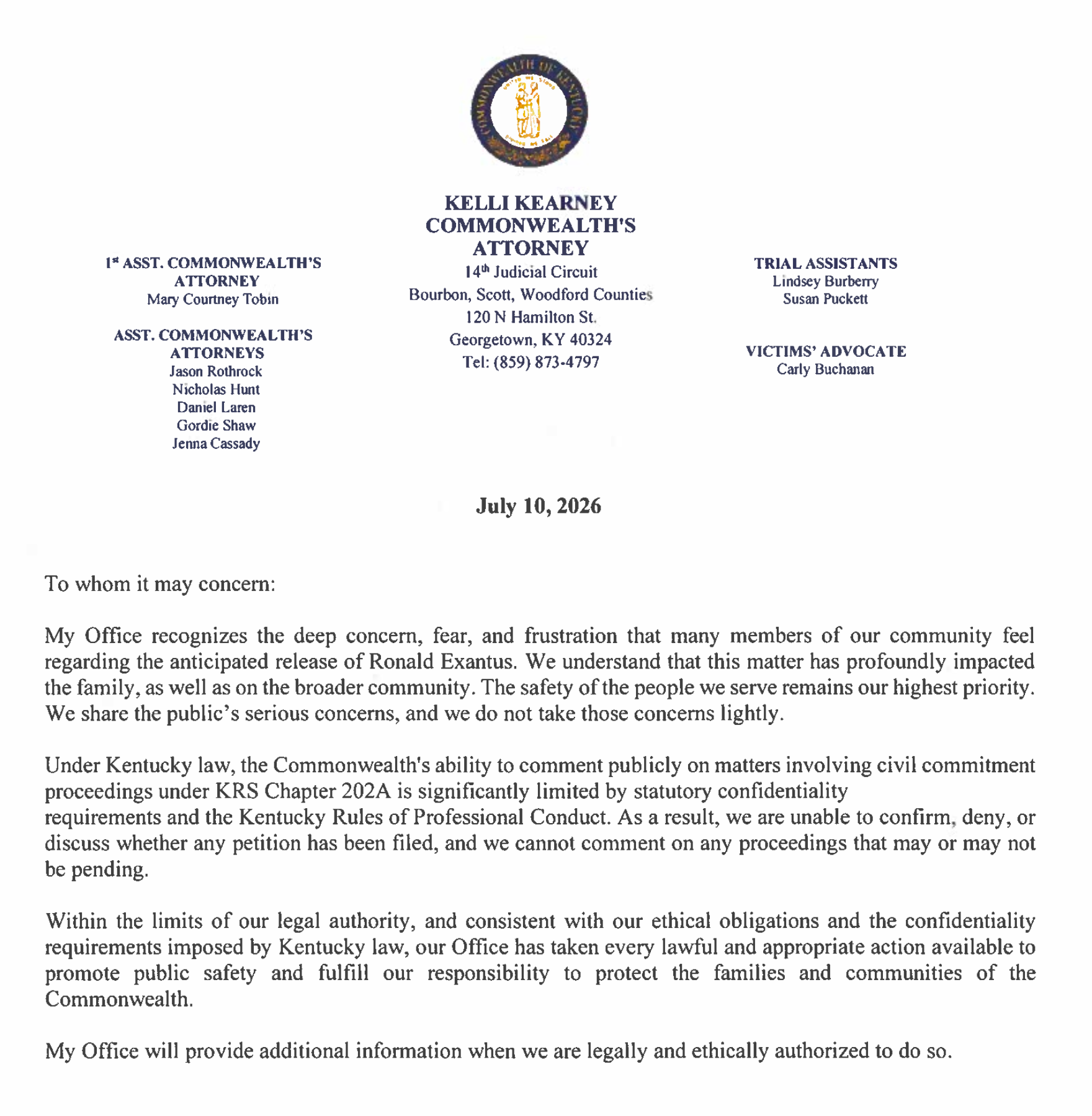
The Commonwealth's Attorney for Kentucky's 14th Judicial Circuit released a statement Friday addressing the looming July 29 release of Ronald Exantus, the man convicted in the 2015 killing of 6-year-old Logan Tipton. But if you were hoping for a straight answer on whether her office is trying to keep him locked up through involuntary hospitalization instead, you won't find it here- and there's a legal reason why.
"My Office recognizes the deep concern, fear, and frustration that many members of our community feel regarding the anticipated release of Ronald Exantus," Kearney wrote. "We understand that this matter has profoundly impacted the family, as well as the broader community. The safety of the people we serve remains our highest priority."
But then comes the part that actually matters right now: Kearney says her hands are tied when it comes to saying anything more specific.
"Under Kentucky law, the Commonwealth's ability to comment publicly on matters involving civil commitment proceedings under KRS Chapter 202A is significantly limited by statutory confidentiality requirements and the Kentucky Rules of Professional Conduct," she wrote. "As a result, we are unable to confirm, deny, or discuss whether any petition has been filed, and we cannot comment on any proceedings that may or may not be pending."
Here's the backstory. Back on June 5, the Justice and Public Safety Cabinet's general counsel, Ann Blaylock, sent a letter to three people: Woodford County Chief Circuit Judge Jeremy Mattox, Kearney, and Department of Public Advocacy attorney Josh Miller.
The letter pointed to something buried in Exantus's original 2018 judgment. Because a jury found him not guilty by reason of insanity on the murder charge, the judge at the time added a specific line to the paperwork: "Prior to the Defendant's release, KRS 504.030 shall apply."
That statute lays out that when someone is found not guilty by reason of insanity, the court is supposed to hold an involuntary hospitalization proceeding- essentially, a hearing to determine whether that person should be committed for treatment instead of simply walking free.
The state's letter made clear the Department of Corrections can't start that process itself, and can't hold Exantus past his sentence expiration date without a judge's order in place first. She gave the three officials formal notice, with more than a month and a half of lead time, to begin those proceedings if they wanted to.
That was five weeks ago. Exantus is set to be released in less than three weeks.
 Shay McAlister
That's the question I put directly to the prosecutor's office this week. And per her statement, that's exactly the question she's not allowed to answer- at least not publicly, not right now.
Civil commitment proceedings under KRS Chapter 202A come with built-in confidentiality protections, similar to a lot of mental health and medical proceedings. Kearney says that statute, combined with professional conduct rules attorneys have to follow, means she legally cannot say whether a petition has been filed, whether a hearing is scheduled, or anything else about where things stand.
What she will say is that her office has "taken every lawful and appropriate action available to promote public safety" within those legal limits.
"My Office will provide additional information when we are legally and ethically authorized to do so," she wrote.

For a family that has spent months saying they feel left in the dark, this latest development probably won't feel like much of an answer. And that's not necessarily Kearney's fault- the confidentiality rules around civil commitment exist to protect due process and privacy in a legal proceeding that, notably, isn't a criminal case. It's a civil one, with different rules entirely.
But it does mean the public may not know whether an involuntary hospitalization petition has been filed until either a hearing happens in open court, or officials are legally cleared to say more.
With Exantus's release date now less than three weeks away, that leaves a narrow-and increasingly tight- window for anyone hoping this ends with him remaining in state custody rather than walking free on July 29.
I've reached out again for any additional clarity officials are able to provide as the date approaches, and will update as soon as I hear back.
Like what you see? Learn more about Shay Informed here! This is honest journalism with compassion and clarity.