How Kentucky's Medicaid crisis actually happened- and what it means for your family

– 18 min read



"I'm Shay McAlister, and this is Shay Informed: an independent, ad-free platform dedicated to honest journalism with compassion and clarity.
This story is a 'Shay Original', which is available to paid subscribers only. You can become a member for $4.99/month and gain access to all of my work, including full interviews, behind-the-scenes content, and my weekly podcast.
Paid subscribers- you can also LISTEN to this story. This was the topic of this week's episode of One More Question. Link at the bottom of the page.
If you've been paying attention to the Medicaid story in Kentucky over the past few months, you've probably felt the whiplash.
The federal government cuts Medicaid. Then the state cuts it further- but lawmakers insist it wasn't really a cut. The governor says there's no money. Then he finds money in a parking garage. Republicans point at Beshear. Beshear points at Republicans. Families show up in Frankfort by the hundreds, and nobody in a position of power seems to be able to give them a straight answer.
I've been covering pieces of this story for a while now. But after a packed Medicaid oversight hearing in Frankfort and a last-minute funding announcement that raised as many questions as it answered, I wanted to try to put it all together- the federal picture, the state picture, and what it actually means for the 1.3 million Kentuckians who rely on Medicaid to live.
So I called someone who reads state budgets for a living.
Dustin Pugel is the Policy Director at the Kentucky Center for Economic Policy, a nonpartisan research organization that has spent 15 years tracking how budget decisions land on real people. I asked him to help me untangle this- in plain language- and then I talked to three Kentucky families who are living inside the consequences right now.
Here's what I learned.
Let's start at the top, because the federal changes and the state changes are two separate things- with different timelines, different mechanisms, and different impacts- and conflating them is part of why this is so hard to follow.
The One Big Beautiful Bill is the federal budget reconciliation act that passed Congress last year. Its impact on Medicaid is substantial, and most of it hasn't hit yet.
The headline most people heard was the work requirement. Starting next year, people who gained Medicaid coverage through the Affordable Care Act expansion- there are more than 400,000 of them in Kentucky alone- will have to prove they are working at least 80 hours a month. They'll also have to re-prove their eligibility every six months instead of once a year.
Policy expert Dustin Pugel explained something that most people don't know: the state actually projects that the more frequent eligibility checks will knock more people off Medicaid than the work requirement itself.
"Back a few years ago when we restarted eligibility determinations after COVID, 60% of the people who lost their benefits lost it because of procedural errors," he told me. Not because they didn't qualify. Because the paperwork didn't go through. This is called administrative burden, and it is, as Pugel put it, "a pretty effective way of knocking people off."
But the work requirement and the eligibility churn are not even the part of the federal bill that worries healthcare economists most. The bigger long-term threat is what happens to hospital funding.
Right now, states can make supplemental payments to hospitals that serve a lot of Medicaid patients- essentially bridging the gap between the very low Medicaid reimbursement rate and what it actually costs to run a hospital. Kentucky has leaned heavily on this tool. Those payments currently total around $5.5 billion a year in Kentucky.
The One Big Beautiful Bill cuts that dramatically.
"The punchline is that we're going to have these supplemental payments to providers go from around 5.5 billion per year to around 500 million per year when they're fully implemented about a decade from now," Pugel said.
Five and a half billion to five hundred million. That's why you're already hearing about birthing centers being closed or scrapped. Pugel mentioned two in Kentucky that have either been dropped or abandoned at the planning stage. As those cuts phase in toward 2028, hospitals that rely heavily on Medicaid patients will face a math problem they cannot solve- their reimbursement goes down, but their costs don't. Some, particularly in rural Kentucky, may not survive it.
And this matters even if you are not on Medicaid yourself. In Eastern Kentucky- already economically depressed after the decline of coal- Medicaid payments to providers make up 13.5% of the regional GDP. When the hospital in a rural county closes, everyone in that county drives further for a colonoscopy, for chemo, for a baby. "The way that Medicaid acts as a stabilizer in the healthcare sector is really profound," Pugel said.
Here's where it gets complicated- and where I think a lot of people, including a lot of journalists, have not told the full story.
The One Big Beautiful Bill's cuts have not fully taken effect yet. What Kentucky families are feeling right now- today- is primarily the result of decisions the Kentucky General Assembly made this session when it passed House Bill 500, the state budget.
These are two separate funding policies. The federal law is a future threat, still phasing in. The state budget is a present crisis, already in motion.
The state budget shorted Medicaid by approximately $690 million over the two-year biennium- about $260 million in the first year and the remainder in the second. That sounds large, but it understates the real impact, because of how the federal match works. For every dollar Kentucky puts into Medicaid for the expansion population, the federal government contributes nine. So when the state reduces its contribution, the total reduction to the program is far larger.
"When the state reduces the amount of money that it puts in, that reduces the amount of money that the federal government matches- even more so," Pugel explained. "There's a real significant impact that happens to the overall budget."
One result of that shortfall: a 4% reduction in Medicaid provider reimbursement rates beginning in 2027, with an additional 3% cut possible in 2028. To understand why families are alarmed by this, you have to understand that those rates were already extremely low. Kentucky already reimburses Medicaid providers about 40% less than neighboring states. Cutting another 4% on top of that creates a real risk that some providers- therapists, home health workers, waiver service providers- will decide they simply cannot afford to keep seeing Medicaid patients.
"Some service providers may have to lay people off, or they may choose to just exit the Medicaid market altogether," Pugel said. "And that is really scary."
Meanwhile, nearly 20,000 Kentuckians with disabilities are currently on the waitlist for home and community-based waiver services- the programs that fund in-home care, respite workers, therapists, and community living supports. This session, the General Assembly added 400 new slots.
Four hundred. Against twenty thousand waiting.
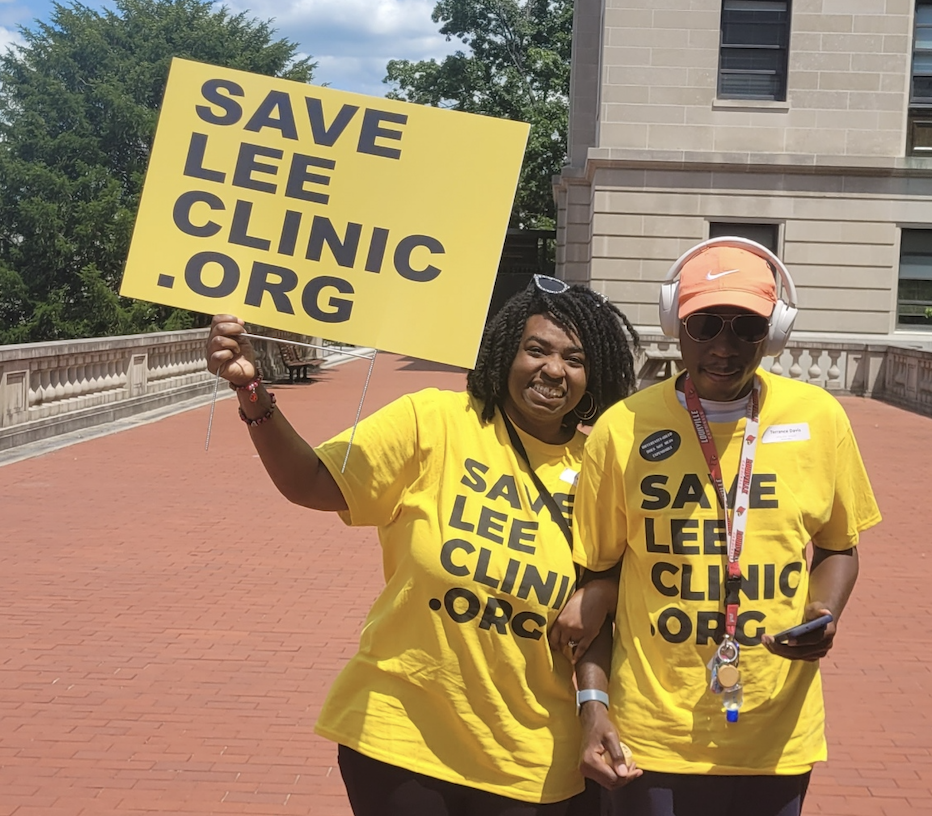
Lee Specialty Clinic- the only comprehensive care facility in Kentucky designed specifically for adults with intellectual and developmental disabilities- didn't lose its funding in a simple, straightforward cut. What happened is more complicated than that, and understanding it matters.
Most people assumed Lee was primarily a Medicaid billing operation. It is not. Its funding came largely through the Department for Behavioral Health and Intellectual Disabilities, the state agency that contracts with facilities like Lee directly. And the way that agency got squeezed is something Pugel explained using a simple analogy.
Imagine the General Assembly gives an agency $100. Last year they got $101, so on the surface, that's only a 1% cut- no big deal. But buried in the budget document, the legislature also requires that agency to spend $5 on this program, $5 on that one, $20 on another. When you add up all the mandated spending and compare it to previous years, the agency is now left with $60 in discretionary funds instead of $70. The top-line number barely moved. The base- the money they actually have flexibility over- shrank by much more.
"What the mandated spending does is create a de facto cut to the base budget," Pugel said.
And the number that really puts Lee's situation in focus: 89% of what the Department for Behavioral Health and Intellectual Disabilities spends is already required by state law. Eighty-nine percent. The discretionary remainder- the money that funded Lee's operating contract- was a small slice to begin with. When that slice got cut, Lee didn't have enough to keep going.
More than 1,100 patients lost their care.
Last week, Governor Beshear announced a last-minute funding commitment for Lee Specialty Clinic- pulled from a fund that had been set aside for renovations to the Capitol Annex building where lawmakers have their offices.
The immediate public reaction was: if the money was there all along, why weren't you using it?
It's a fair question, and Pugel explained it simply: money isn't new. Using it for Lee means not using it for something else. And the something else, in this case, is a project that happens to benefit the legislators who passed the budget that created this problem in the first place.
"That's not a long-term solution," Pugel said. "That's just a recipe for more fights."
He also pointed out that the legislature put more than $300 million into its savings account this session- money that could have been spent on these priorities but wasn't. "What do we do with the money that we're not spending that we could be putting toward these priorities? That's a real question mark."
On the broader question of who is responsible- the governor or the legislature- Pugel was careful but clear. Both play a role. The legislature holds the power of the purse. They passed a budget with $690 million less in it for Medicaid, and they were explicit about that. The governor controls how those cuts are implemented. Both branches have been doing more blaming than solving.
"I really wish they could drop the finger pointing and try to come up with a solution together," Pugel said. "From my read of the budget, the solution really has to come with an adequate budget that serves everyone. There's no way to efficiency our way out of care for people with disabilities or care for people in hospitals. At the end of the day, a lot of it just requires that we appropriate more money."
And there is a larger question sitting underneath all of this that the General Assembly will have to confront when they return in January. Kentucky has cut its state income tax by roughly $2 billion a year over recent years. The state's general fund has been roughly flat as a result. Pugel put the tradeoff plainly: most Kentuckians saw their take-home pay increase by about 1.5% from those cuts. "Is it worth it," he asked, "to these thousand families at Lee Specialty Clinic, or to the 1.3 million Kentuckians who are cared for through Medicaid, or the 700,000 students who go to our public schools?"
That question doesn't have a politically easy answer.