What parents need to know about the CDC's new childhood vaccine schedule

– 3 min read



This week the US Department of Health and Human Services announced the CDC has adopted a revised childhood vaccine schedule. The announcement was met with criticism from major medical voices, including the American Academy of Pediatrics, which opposes the changes, calling them “dangerous and unnecessary.”
"I'm Shay McAlister, and this is Shay Informed: an independent, ad-free platform dedicated to honest journalism with compassion and clarity.
Are you new here? Sign up for the free weekly newsletter or subscribe to support our mission and access behind-the-scenes content, podcasts, and in-depth stories reserved for paid subscribers.
If you're a parent scrolling through social media right now, you've probably seen something about changes to childhood vaccine recommendations. I've read through the official documents from the Department of Health and Human Services, and here's what's actually changing and what it means for your family.
On January 5, the CDC adopted a revised childhood immunization schedule following a directive from President Trump to review how other developed countries handle childhood vaccinations. The result? A new set of recommendations from the federal government about what vaccines children should get, and when.
According to the documents provided by the White House, the new schedule wasn’t driven by any new evidence on the safety and effectiveness of vaccines. It was created to give parents "more flexibility and choice."
The new recommendations group vaccine recommendations into three categories:
Category 1: Recommended for all children
These are what the decision memo calls "consensus vaccines"- the ones where there's broad international agreement. This list includes measles, mumps, rubella, polio, whooping cough (pertussis), tetanus, diphtheria, Hib, pneumococcal disease, HPV, and chickenpox (varicella).
Category 2: Recommended for certain high-risk groups
According to the CDC, some vaccines that were previously recommended for all children are now being labeled as only necessary for kids with specific health conditions or circumstances. This includes RSV, and vaccines for hepatitis A and B (depending on risk factors), meningococcal disease, and dengue.
Category 3: Shared clinical decision-making
This is the new language you'll hear at your pediatrician's office. It means vaccines for hepatitis A and B, rotavirus, meningococcal disease, flu, and COVID-19 are available and covered by insurance, but the recommendation is now that parents and doctors should talk through whether they make sense for each individual child based on their specific situation.
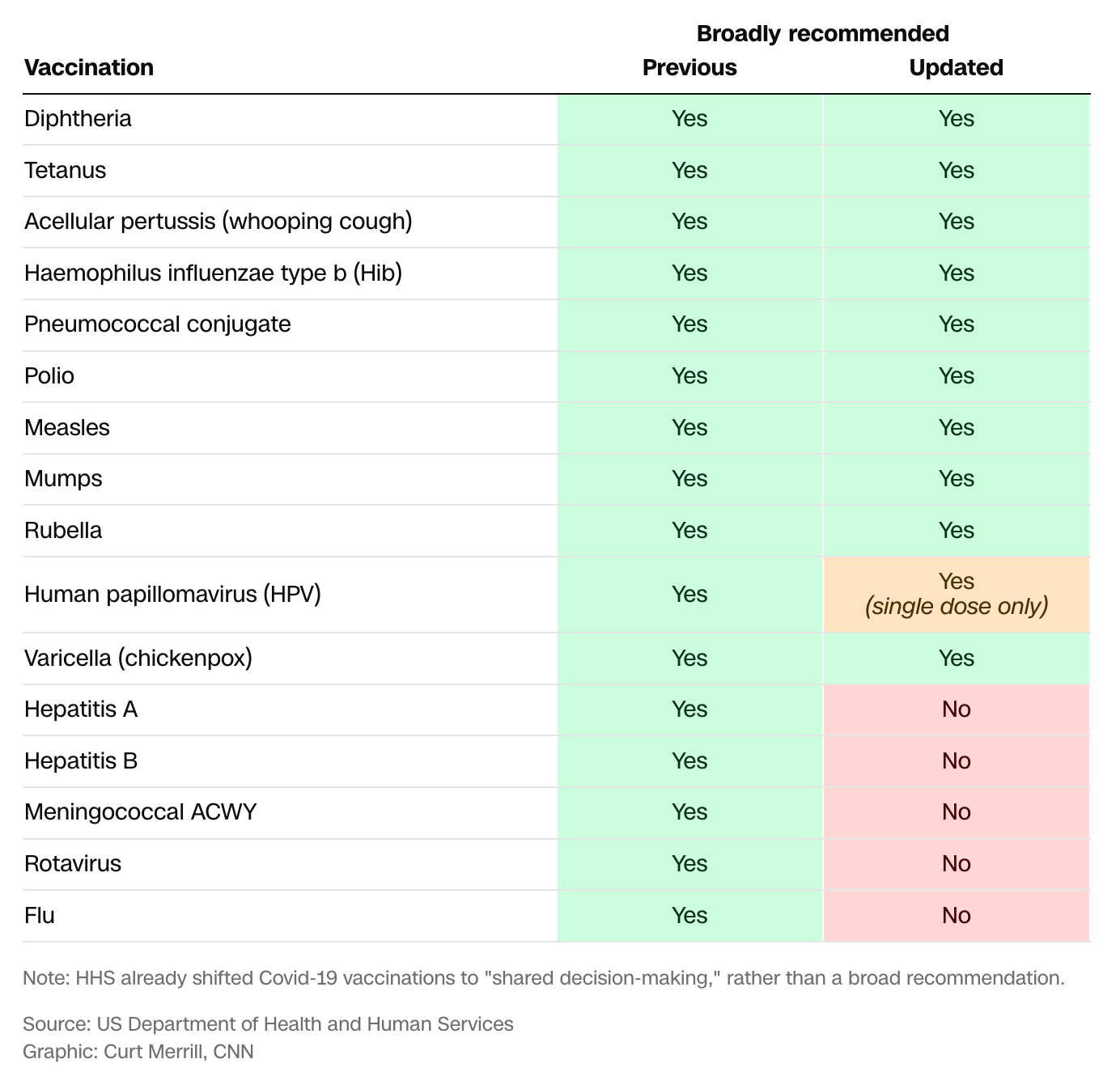
According to the documents provided by the White House, the U.S. currently recommends vaccines for more diseases than any of the 20 peer nations reviewed. The decision memo notes that many countries with fewer recommended vaccines still maintain high vaccination rates and good child health outcomes. But it is important to note that these claims have been challenged by US health officials.
If your child is already vaccinated or on the current schedule, nothing changes immediately. If you have a well-child visit coming up, expect your pediatrician to have more detailed conversations with you about vaccines in that third category.
As for cost, according to the memo from the White House, you won't be charged for any of them, and insurers will still have to cover all vaccines recommended by the CDC.
Your child's doctor is likely still processing what this means for their practice. The CDC says it will work with state health agencies and physician groups on implementation and education.
Experts say now it is more important than ever to have conversations with your trusted pediatrician about what is best for your family.
The American Academy of Pediatrics is still publishing its own recommended childhood vaccine schedule, which is much broader than the government's list. AAP President Dr. Andrew Racine opposes the changes, calling them “dangerous and unnecessary.”
Dr. Mandy Cohen, former director of the US Centers for Disease Control and Prevention, said the “shift in vaccine recommendations from HHS adds confusion and unnecessary obstacles for families who want their kids protected from serious illness. I am saddened to see our country take a step backwards in its efforts to protect the health of children and families.”
The Infectious Diseases Society of America called the changes “reckless” and characterized the decision as an “assault on the national vaccine infrastructure that has saved millions of lives.”
The childhood vaccine schedule is being reorganized, not eliminated. All vaccines remain available and covered. Some vaccines will now require more discussion between you and your child's doctor rather than being universally recommended.
Conversations with a trusted medical provider are considered more important than ever.
Like what you see? Learn more about Shay Informed here! This is honest journalism with compassion and clarity.