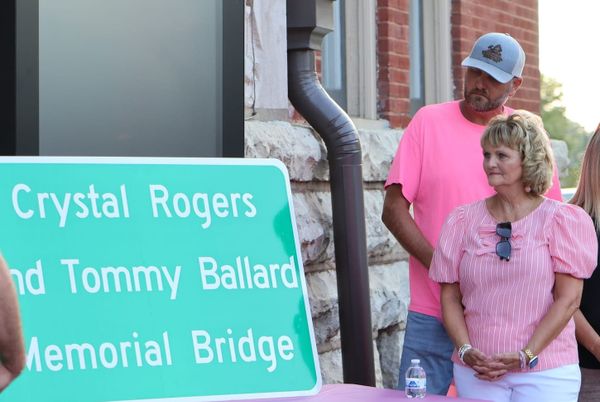
Kentucky's new railroad vegetation law takes effect today. One family went to check if it mattered.

– 7 min read



Three years after her son Hunter's death, Tanya Serna returned to the Kraft Road crossing- and found the same overgrowth that made it a "blind spot" in 2020.
"I'm Shay McAlister, and this is Shay Informed: an independent, ad-free platform dedicated to honest journalism with compassion and clarity.
Are you new here? Sign up for the free weekly newsletter or subscribe to support our mission and access behind-the-scenes content, podcasts, and in-depth stories reserved for paid subscribers.
Today, for the first time in Kentucky's history, it is against the law for a railroad company to let vegetation grow unchecked at a public crossing.
Tanya Serna has waited six years for this day. So this morning, she and her husband Robert drove out to the Kraft Road crossing in Rineyville- the place where their 19-year-old son Hunter was killed in a 2020 collision- to see it for herself.
What she found, she described as the same overgrown grass that she said obscured the view the night Hunter died.
"I was hoping that I would find something different, but I knew that I wouldn't," Tanya said. "I knew that the trees were going to be overgrown."
Serna told me the grass was almost as tall as Hunter's memorial crosses.
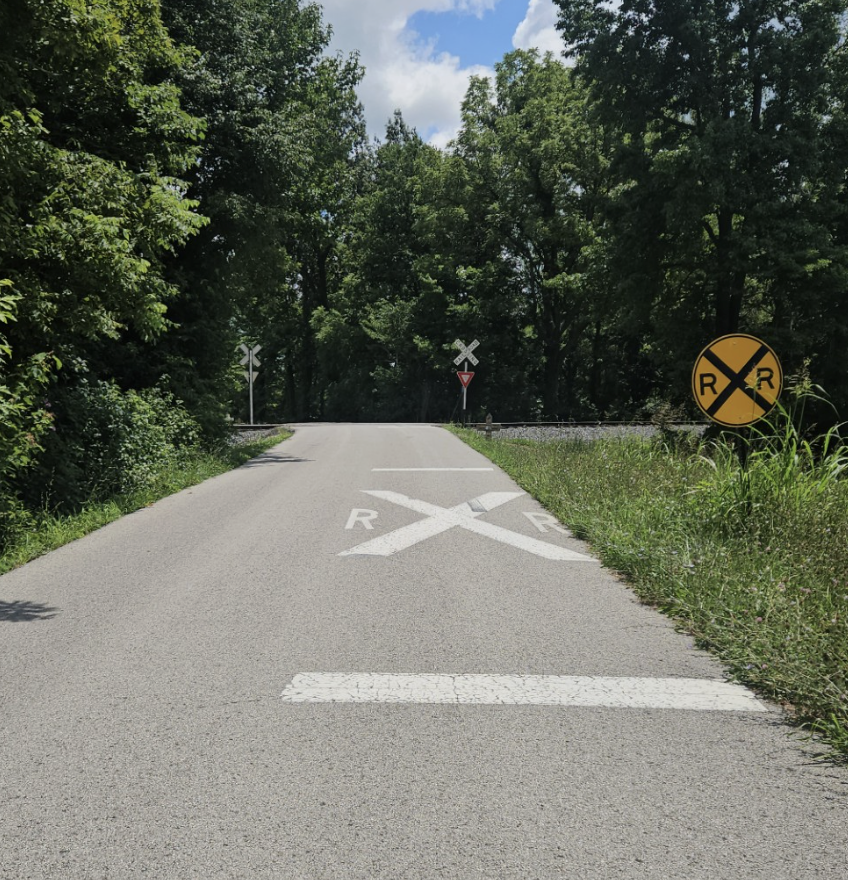
House Bill 311 requires railroad companies to clear obstructive vegetation within 250 feet of a public crossing in each direction. If a railroad fails to comply, the Transportation Cabinet or local government can send written notice requiring the vegetation be removed within 30 days. If the railroad still doesn't act, the state or local government can clear it themselves and bill the company for the cost.
Kentucky is now the 35th state in the country with a statutory vegetation-clearance requirement for railroad crossings.
Getting here took three straight years of advocacy from Tanya- she first asked lawmakers for help in 2024. The bill was proposed that year, the next, and again this year. She told me she retired from her job as a school secretary this year so she could spend more time in Frankfort, talking to lawmakers herself.
 Shay McAlister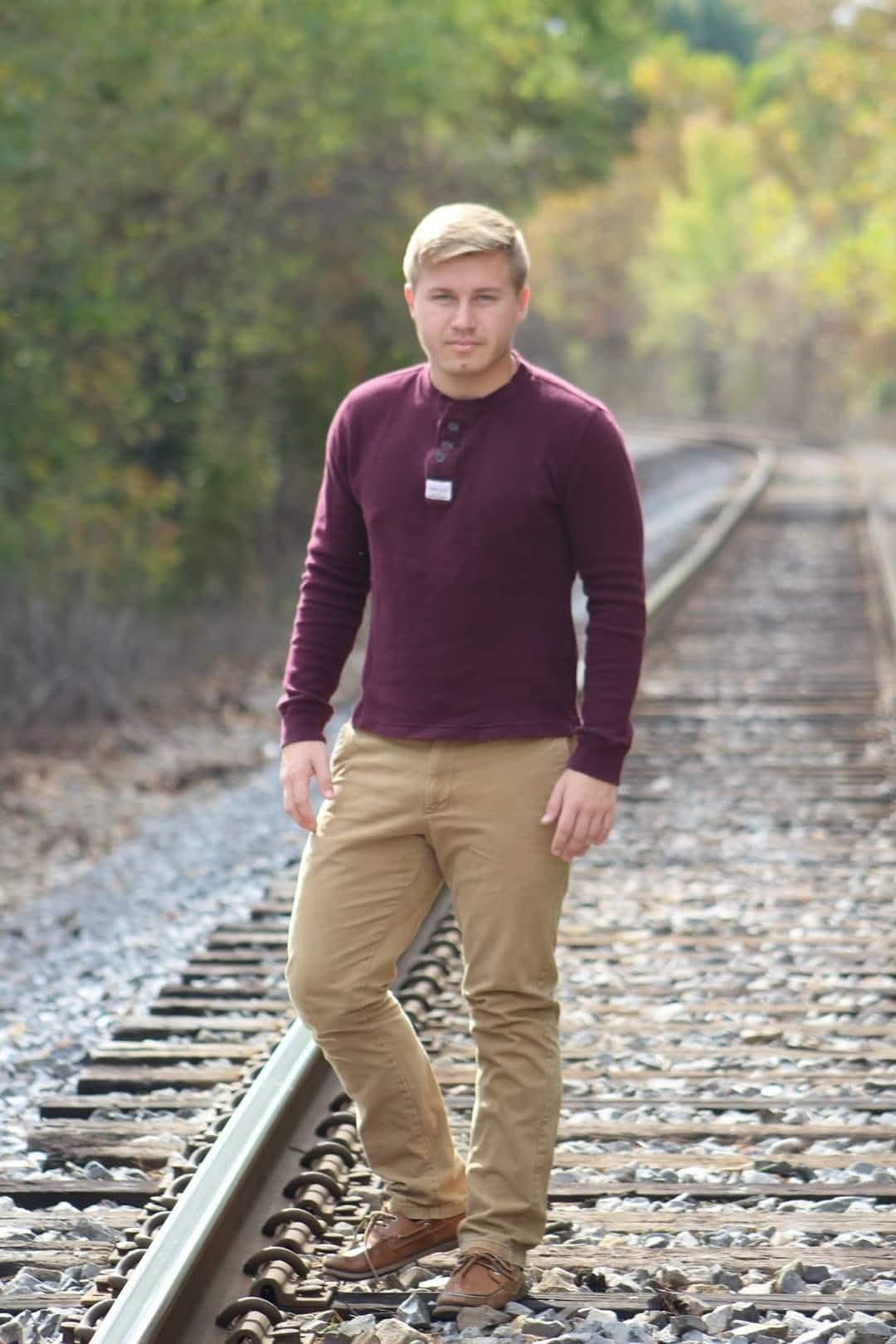
"I literally had to retire this year because I knew that nothing can be really done unless I go up there and personally meet the representatives and the legislators," she said. "Three straight years- making phone calls every day, sending emails out, setting up appointments, going up to Frankfort at least once a week when I could."
She said many lawmakers had no idea Kentucky lacked this kind of law until she told them. "There was, I'm going to say, probably 75% of them not even aware that there was no statutory law in the Commonwealth of Kentucky requiring railroad companies to clear vegetation. They were appalled. They were shocked."
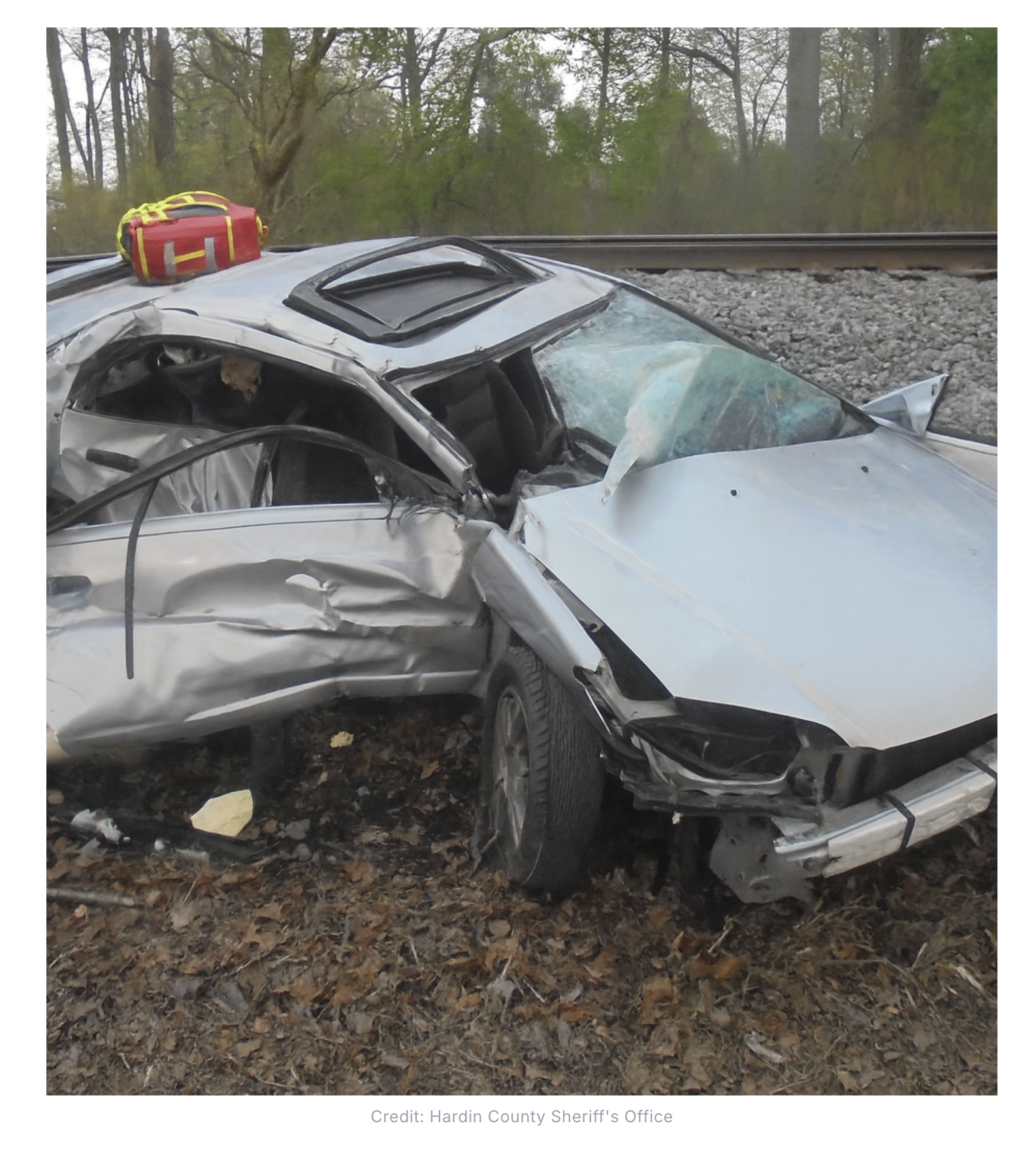
Tanya's son Hunter was killed in a train crash when the car he was riding in crossed over the track and was hit by an oncoming train. The driver, who survived, said he didn't see the train approaching because overgrown vegetation blocked his view.
The law technically took effect today. But there's an important caveat buried in the bill's text: railroad companies have until January 1, 2029, to come into full compliance. So the overgrown crossing Tanya found this morning isn't necessarily a violation- not yet.
That timeline is part of what she's now trying to make sure people understand and don't let slide into the background for the next three years.
"Awareness is action," Tanya said. "It falls back onto the local governments and the public works because if you're not aware of it, nothing's going to be done."
After today's visit, Tanya said she contacted Hardin County Public Works, which she said clears vegetation at the site roughly once a month. She also said she left a message with the railroad company's toll-free safety line, posted on the blue emergency contact sign at the crossing.
The Kraft Road rail crossing is on county property.
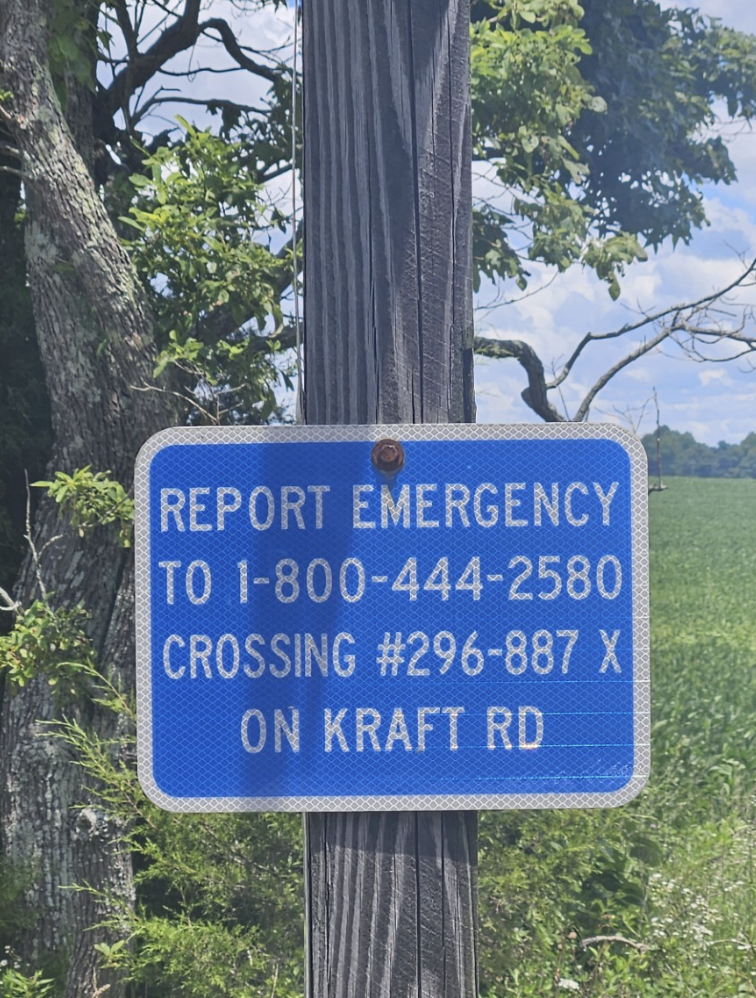
"I'm going to be that proactive person and make sure it is taken care of," she said. "That's step one."
Despite finding the crossing unchanged, Tanya said today felt different than every other visit she's made there over the past three years.
"It's overwhelming knowing that this law is in effect," she said. "I know all the hard work that my husband and I have put into this, and Representative Callaway and Representative Tate and all of the other sponsors for this bill and all the support that we've received... I've always been told to be cautiously optimistic. Now I can be optimistic. I can do something. I can make those phone calls. They have to follow through. They have to make a change."
She's not stopping at Kraft Road. On the drive home, she and Robert passed and photographed several other crossings where she said she found the same visibility problems.
Tanya said she's now considering reaching out to judge executives across the state to make sure local officials know the law exists and understand their role in enforcing it.
"Unless we, the people, are proactive, it's going to get swept under the rug," she said. "In order for that to happen, awareness has to be [spread]."
She says the fight now shifts from passing the law to making sure it's actually enforced over the years leading up to the 2029 compliance deadline.
"You can't just stop by saying it's passed. Oh yay, joy! No- it's got to go further than that."
Hardin County Responds
According to officials with Hardin County, Kraft Road and other county-maintained crossing approaches are inspected monthly for signage issues, and the county mows its right-of-way three times a year. The county said it added pavement markings at the Kraft Road crossing in June 2020, following the collision, though it maintains it "was not deficient prior to the additions" and considers the markings "another layer of safety."
On enforcement under HB311, the county was direct about where responsibility lies: "The law clarifies the responsibility of the railroad to maintain its property. There is no requirement for the county to inform the railroad if there is an issue." The county noted that while it may report vegetation problems to a railroad, it is only obligated to act- clearing vegetation itself and billing the railroad- if a report goes unresolved after 30 days, and even then, only with the railroad's express consent to access its property.
For residents who spot an overgrown or obstructed crossing, the county said the responsibility to report it falls on the public to contact the railroad directly. Every crossing has signage posted with the specific railroad company's contact information. Concerns about county-owned property near a crossing can be directed to the Hardin County Road Department at (270) 737-6046..
Kentucky Transportation Cabinet Response:
Team Kentucky’s top priority is safety.
HB 311 primarily directs railroad companies to clear obstructive vegetation within 250 ft. of public railroad and highway grade crossings. If they do not, the Transportation Cabinet or local government that owns the roadway may provide written notice and if no action is taken within 30 days, the appropriate agency will clear the vegetation and seek reimbursement from the railroad company.
The Transportation Cabinet will also review and process waiver requests from railroad companies. The compliance component of the law takes effect Jan. 1, 2029 and the Cabinet is currently researching and developing procedures to ensure compliance with the law, including details about reporting concerns. Kentuckians may call the railroad’s 800 number posted at the crossing if there is an emergency.
Like what you see? Learn more about Shay Informed here! This is honest journalism with compassion and clarity.