Why can't Louisville solve homelessness? Ten years of answers- and starting over.

– 18 min read


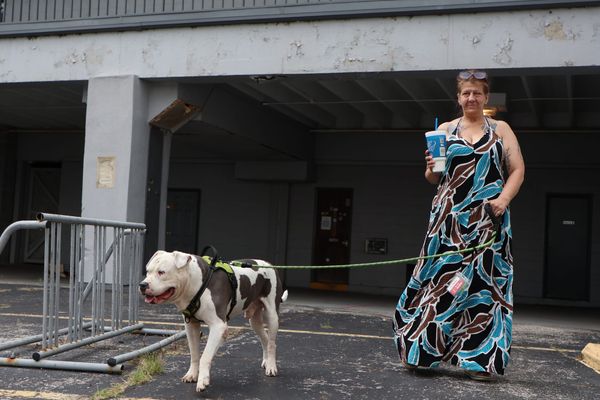
The Arthur Street Hotel closes its doors this month. The people who ran it have spent years watching Louisville build solutions, defund them, and start over. This is their story- and the city's.
"I'm Shay McAlister, and this is Shay Informed: an independent, ad-free platform dedicated to honest journalism with compassion and clarity.
This story is a 'Shay Original', which is available to paid subscribers only. You can become a member for $4.99/month and gain access to all of my work, including full interviews, behind-the-scenes content, and my weekly podcast.
This story does have a podcast version- find it at the bottom of this page!
It's early July, and the heat index is already in the triple digits when I pull into a parking lot just off Interstate 65, south of downtown Louisville. The building in front of me looks exactly like what it used to be- a motel. Rows of doors, all facing a courtyard.
I'm here to meet someone I've known for most of the last decade. I met her under a viaduct at a homeless camp clear-out in 2018, handing out food from the trunk of her car. Her name is Christen Herron. Everyone- and I mean everyone- calls her Tiny.
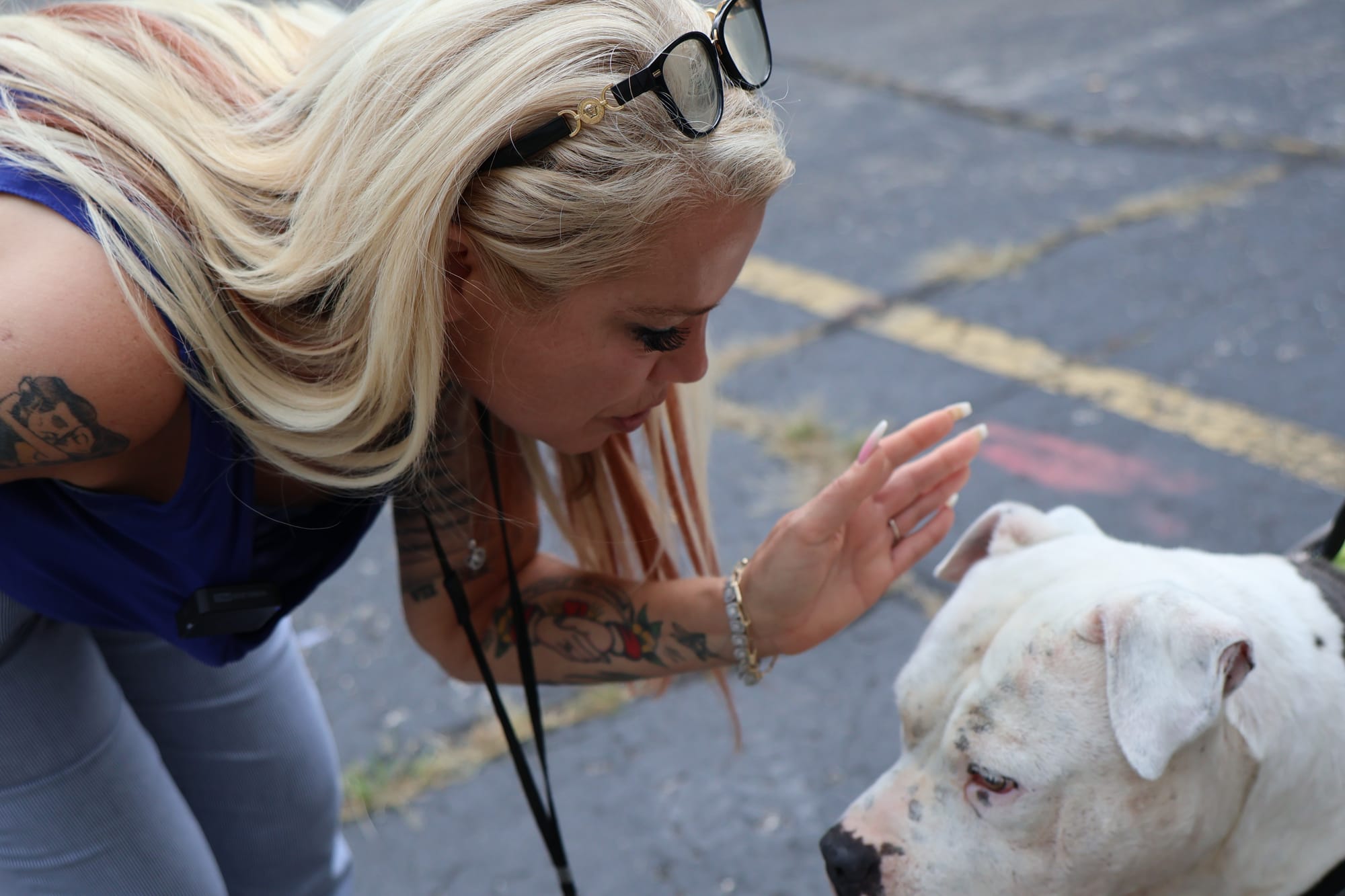
"We're standing out in the middle of the parking lot, looking over, and it looks like a motel," she says. Inside, the rooms look like a motel too- on purpose. "You have your own bed, your own bathroom, a microwave, a small refrigerator in the room, and a smart TV that has apps, so folks can access the internet. And a phone in the room."
This is the Arthur Street Hotel. Since it opened in October 2022, more than four hundred people have walked out of this parking lot and into permanent housing.
And by the end of this month, it will be closed.
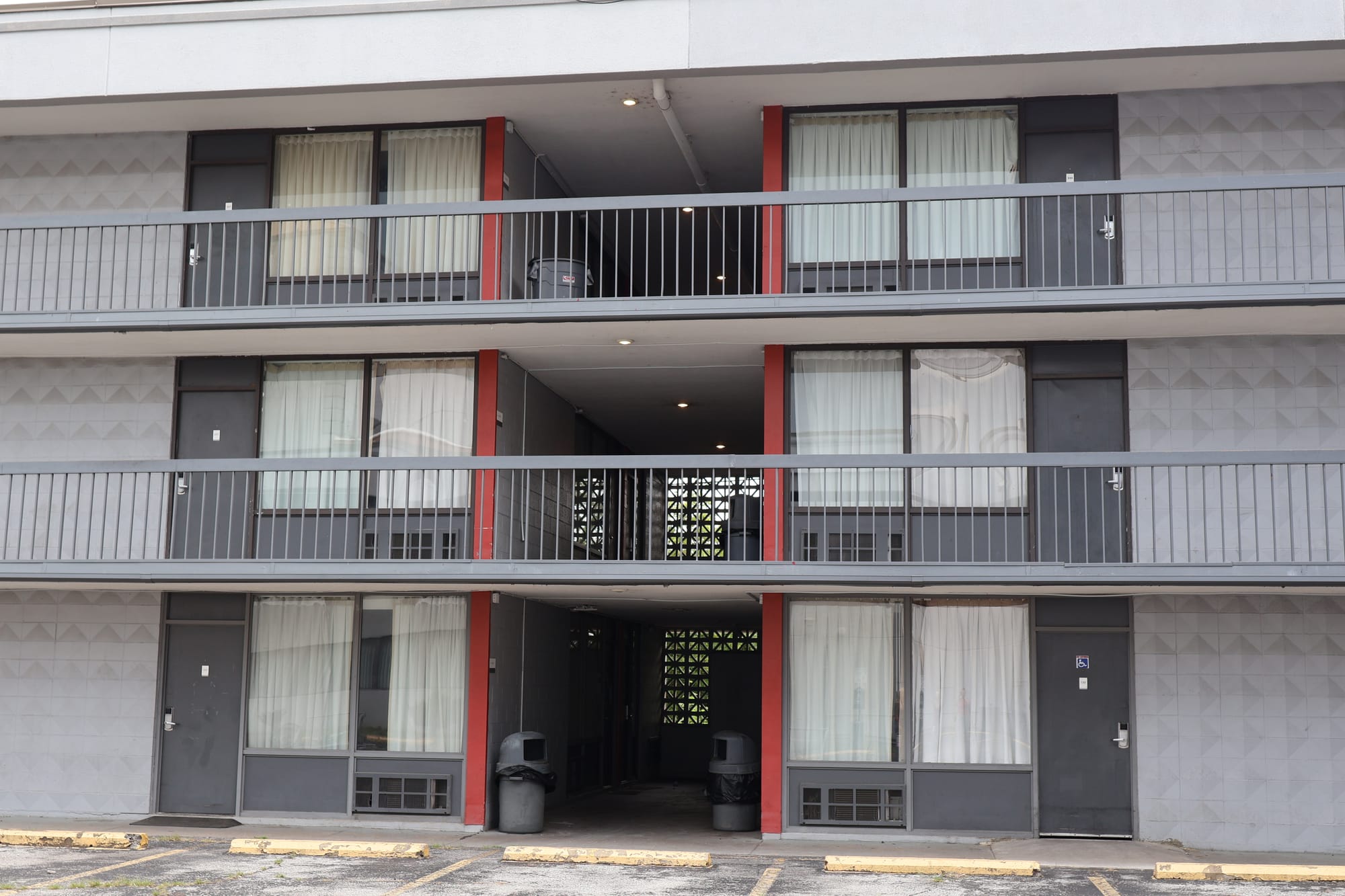
"It's sad to have empty rooms," Tiny says. "I should not have empty rooms at all- especially when there are people outside on the sidewalks right now that need space."
So how did it happen? That depends on who you ask.
Because this isn't really a story about one hotel and one budget line. It's a story about the last ten years in Louisville- about a city that keeps building things, and keeps walking away from them.

To understand what's being lost, you need to understand what this place actually is. It is not an emergency shelter. And the people who live here are, in many cases, people no other shelter in this city will take.
"The majority of individuals that have come through our doors here have been turned away from every other place," Tiny says. Other shelters keep what they call a ban list- and some of those bans are permanent. "We never initiate an infinite ban or bar, because we believe that people can change", Tiny told me with a grin.
As she says it, she points to a tattoo on her arm that reads that very phrase: People can change.
That belief comes down to one reframe. What other places treat as "behaviors," Arthur Street treats as symptoms.
"When somebody comes through our lobby and they're angry and aggressive, they might be yelling," Tiny says. "It's not, oh my gosh, what's wrong with that person? It's, oh man, what happened? We understand you have a right to walk through these doors and be angry, because you've been on the street for ten years and that's unacceptable."
Here's how it works in practice. Louisville has always moved people straight from the street- sometimes literally from a tent- into an apartment through the housing voucher program. A caseworker or outreach worker helps with the paperwork, and then: here's your key, good luck.
"What we do in this transitional period is something that's never been here in Louisville before," Tiny says. Arthur Street built the thing that was always missing- the in-between.
She describes it as reordering the whole sequence. "We used to say find, house, stabilize- find is your outreach, house is putting them in an apartment, then you begin to stabilize. What we've been doing here for three and a half years is something incredible. We find, we stabilize, we house. And it makes perfect sense", Tiny said.
That stabilizing period is the point. People are resting. They're getting counseling and connected to resources. They're learning life skills- and they're doing it in a safe space, with caseworkers right there.
You don't have to take Tiny's word for it. I talked to a woman who lived at the hotel after six years of finding a new place to sleep every night. Her name is Kayla Schultz.
"We were staying different places- at schools, on tarp benches, just staying wherever we could," Kayla says. "And of course you're not allowed to be on the property of restaurants or anything like that, so we would get kicked out of almost everywhere we went. It was really difficult."
When Kayla finally walked through Arthur Street's doors, she wasn't expecting much. She'd learned not to. Instead she was met with kindness, and a safe place to sleep for the first time in years.
"Walking through them doors, I was able to feel safe again," she says. "Everybody that works here cares about their job and cares about everybody here. You can tell by the way they work with us, the way they talk to us. They have more patience than I've ever seen anybody have."
When Kayla arrived, she had no birth certificate, no Social Security card, no ID- the three documents you cannot get a housing voucher without. Tiny's team helped her secure all three, and the voucher, in a matter of months.
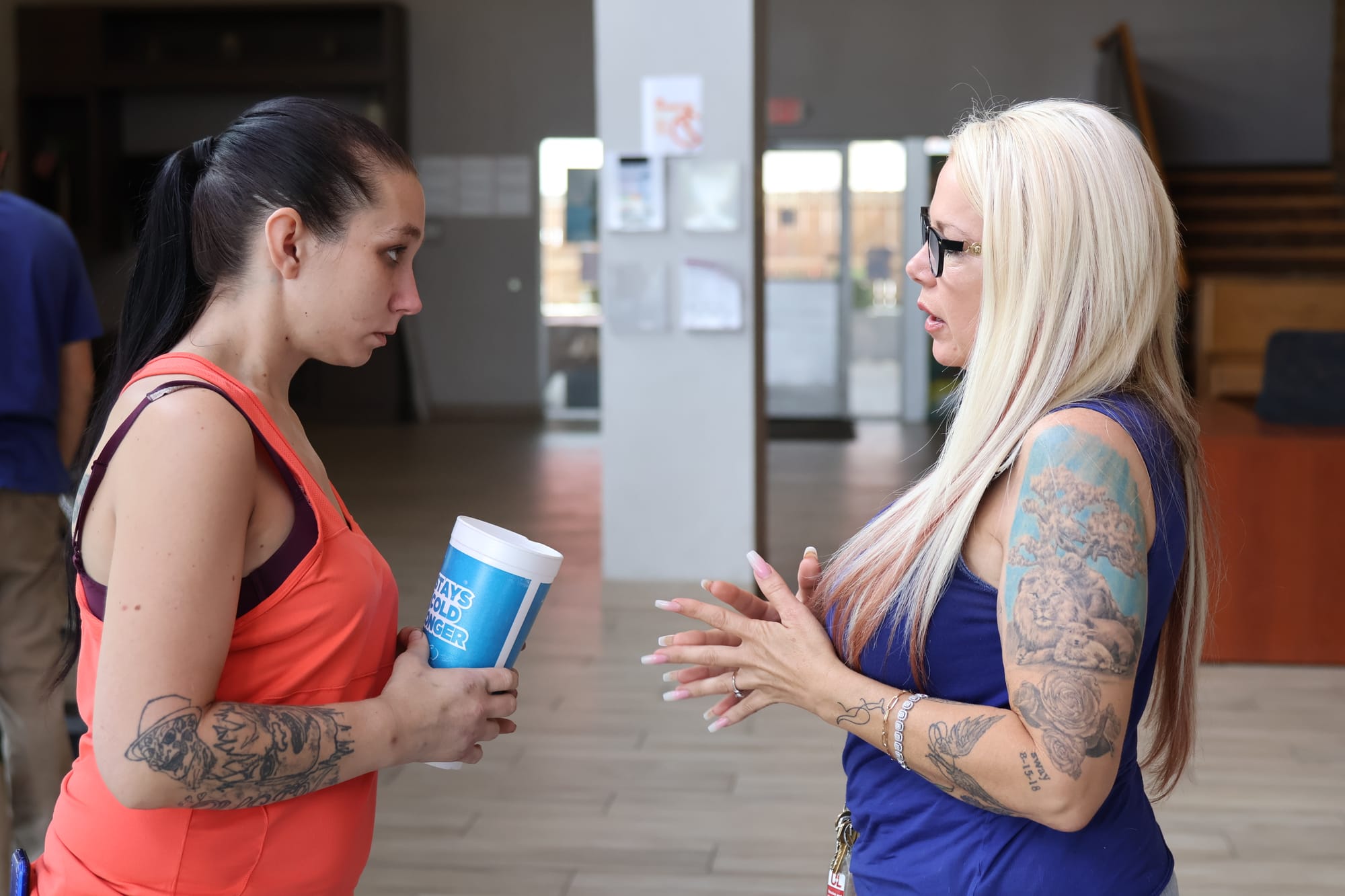
That's why the closure lands the way it does for her.
"I knew that if I needed something, I could depend on them," Kayla says. "So now, with them closing- whenever I move out, it terrifies me. Because I don't know who to turn to, who I can call for help. If I had the money to save it, I would in a heartbeat."
Kayla is one of the roughly four hundred people who arrived at this lobby homeless and left with an apartment of their own.
So how does a program with results like these end up closing? To answer that, we have to go back a decade- to where my own reporting on this began, and where I met Tiny.
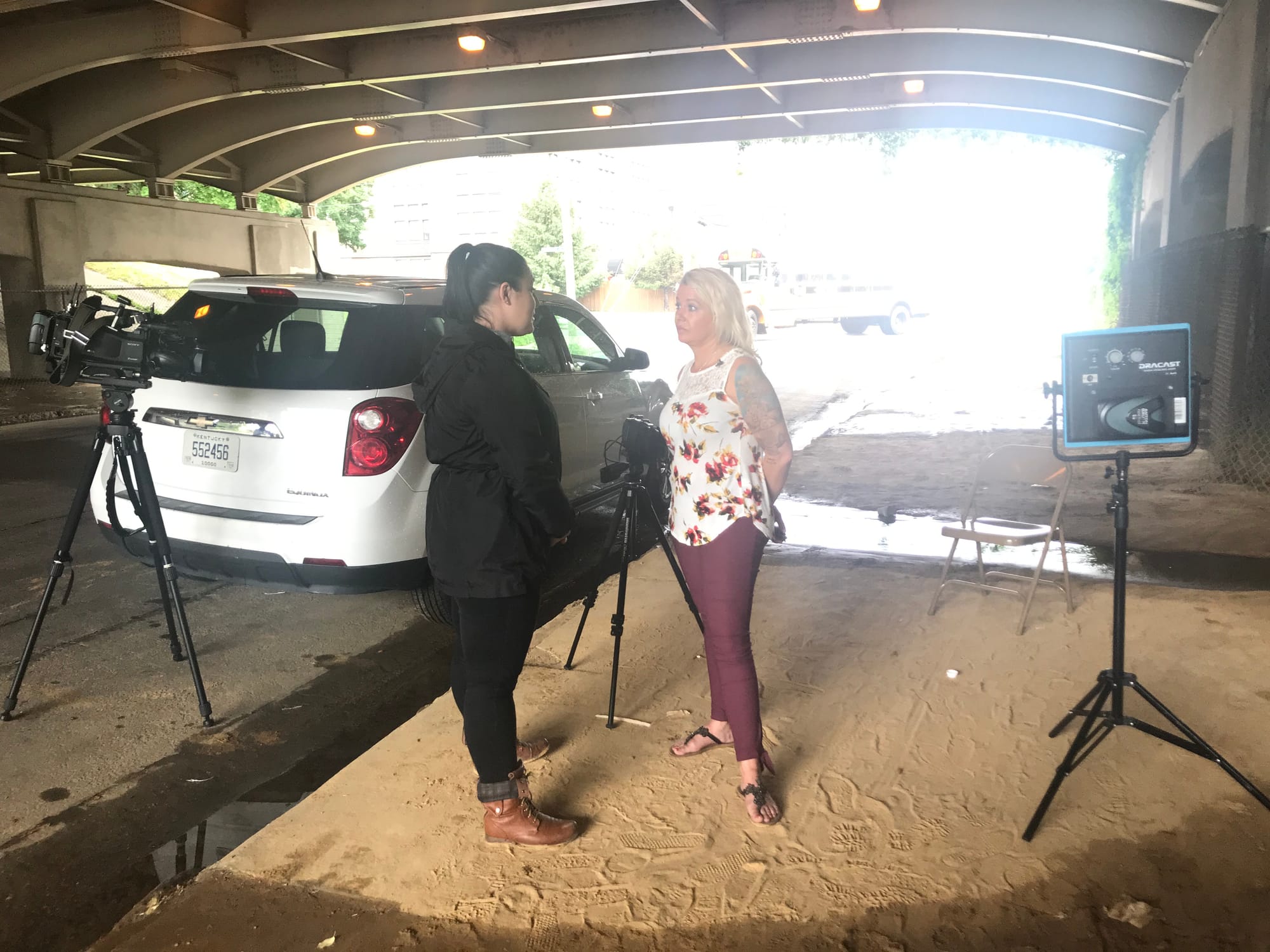
To understand how we got here, you have to go back to a winter that changed how this city treated its unhoused residents- and it's where my own reporting on this issue began, at the camp clear-outs, where I first met Tiny.
"I think back to 2018, and it was a stressful time in our city," Tiny says. "Homelessness was extremely visible. Our streets were lined with folks in tents along the sidewalks. But we had so much momentum. We had a seat at the table with that administration."
Let me set the scene. I was a street reporter then, and someone sent me a tip that the city had bulldozed a homeless encampment- that everyone living there had lost everything they owned. When I went to check it out, I met Tiny.
The city had come without warning, she explained. And when I asked how people were normally warned, she told me that usually she or another volunteer outreach group would get a heads up. Nothing official- but something. This time, nothing.
That's when I learned that most of the homeless services in our city were run by volunteers: people serving food out of their cars, doing pulse checks on cold nights, handing out water on the hottest days. All volunteers, all using their own money. The city had no official services for this. It blew me away.
So people like Tiny started nonprofits- like The Forgotten Louisville- to do the work many believed the city should be doing.
"I began doing outreach on my own, just out of my car, by myself," Tiny says. "And that evolved into the beautiful Forgotten Louisville that it is today."
The Forgotten Louisville is now dozens of volunteers who go out every week in their own cars, filled with food, water, clothing, supplies, harm reduction, and open hearts. They help people survive on the streets and support them when they're ready for a change.
So when Tiny learned the city had sent bulldozers to a camp and destroyed the tents her team had provided- thrown away birth certificates they'd worked hard to replace- she was furious. And she made it known.
"We had a really big meeting with a lot of local government officials," she says. "And we were demanding changes."
In response, Metro Council passed an ordinance requiring 21 days' notice before any encampment could be cleared. Mayor Greg Fischer backed it- and asked for more feedback. How does the city tackle this compassionately and effectively?
"I remember being pretty loud in that meeting," Tiny says. "Like, if this was a natural disaster, our city would be opening up the stadium to put folks in. But out of that meeting came solutions."
The first was a low-barrier shelter. "It used to be, in our city, if you were under the influence, if you had untreated mental illness, if you had a partner, a pet, or a lot of possessions, you could not access shelter," Tiny says. "That's ridiculous. So we demanded a low-barrier shelter, and we got it."
A space that allowed couples, pets, and belongings- a first for Louisville. "That's shown to be effective. It's still being funded to this day," she says. "We then said, we need a safe outdoor space. Other cities were doing this. One advocate even took some local politicians out to Denver to tour one. We got it."
The safe outdoor space is a city-owned property where people can live in tents temporarily, store their belongings, and get wraparound services- built for the people who don't trust the shelter system.
And after the outdoor space came city-funded outreach: the very thing Tiny had been doing after her nine-to-five for a decade. Now she was recruited to lead it- and she knew exactly what to do.
"Outreach is really about building trust, relationships, connection," she says. "You're not going to offer someone services on the street if you don't have rapport because so many of the systems that have already failed them are the same systems out here trying to get them help. It's consistently showing up, meaning what you say and saying what you mean. By the time trust is built, you're able to get somebody connected to services."
That same year, the Fischer administration hired a University of Louisville research team to study the whole system. The woman who led it is an occupational therapist with a PhD in public health named Susan Buchino. Her team's finding was stark: the city was handing out money, but nobody was checking whether any of it produced results.
Her first recommendation was to bring the groups together- force the conversation, and evaluate the outcomes.
"That homeless services initiative actually started to get people together," Buchino says. "All the providers getting money had to come, on a monthly basis, to talk. They hadn't done that before. And it was amazing, because they were learning about each other. They started working more collaboratively. It was very siloed before that."
It's worth pausing here, because I didn't understand this when I started reporting on Louisville's homelessness crisis a decade ago. The Coalition for the Homeless is charged with distributing federal money to local groups; it focuses on education and advocacy, and it's supposed to be uniting the small agencies to get everyone working together. Buchino says that, at the time, that wasn't happening. "Quite frankly, I didn't really understand the purpose of the Coalition for the Homeless at the time," she says. "I was like, you all don't actually have a coalition."
So her team made it a recommendation. They also recommended the city start evaluating its programs and start paying for outreach- work that had been entirely volunteer until then.
She watched things change. Advocates had a seat at the table. Research was turning into programs. She was seeing what happens when the city builds on the people already doing the work.
Then she watched what happens when it doesn't.