What is a thank-you worth, fifty years late? Come along for the Honor Flight Bluegrass
– 14 min read


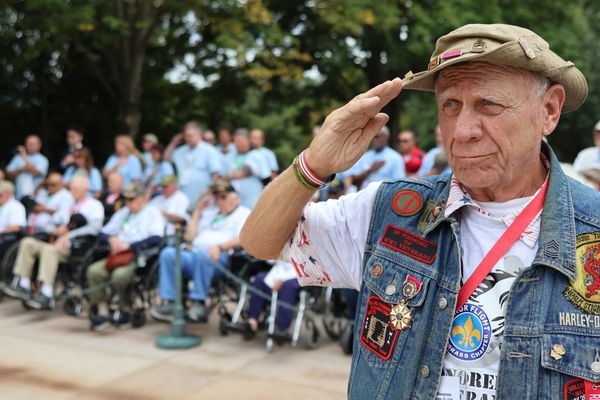
Eighty-four veterans flew from Louisville to Washington, D.C. Eighty had served in Vietnam. On one long day, the country tried to say what it didn’t say then.
This week my podcast episode is FREE for everyone! Listen below, and if you like what you hear, subscribe to get access to all of my podcasts and in-depth work.
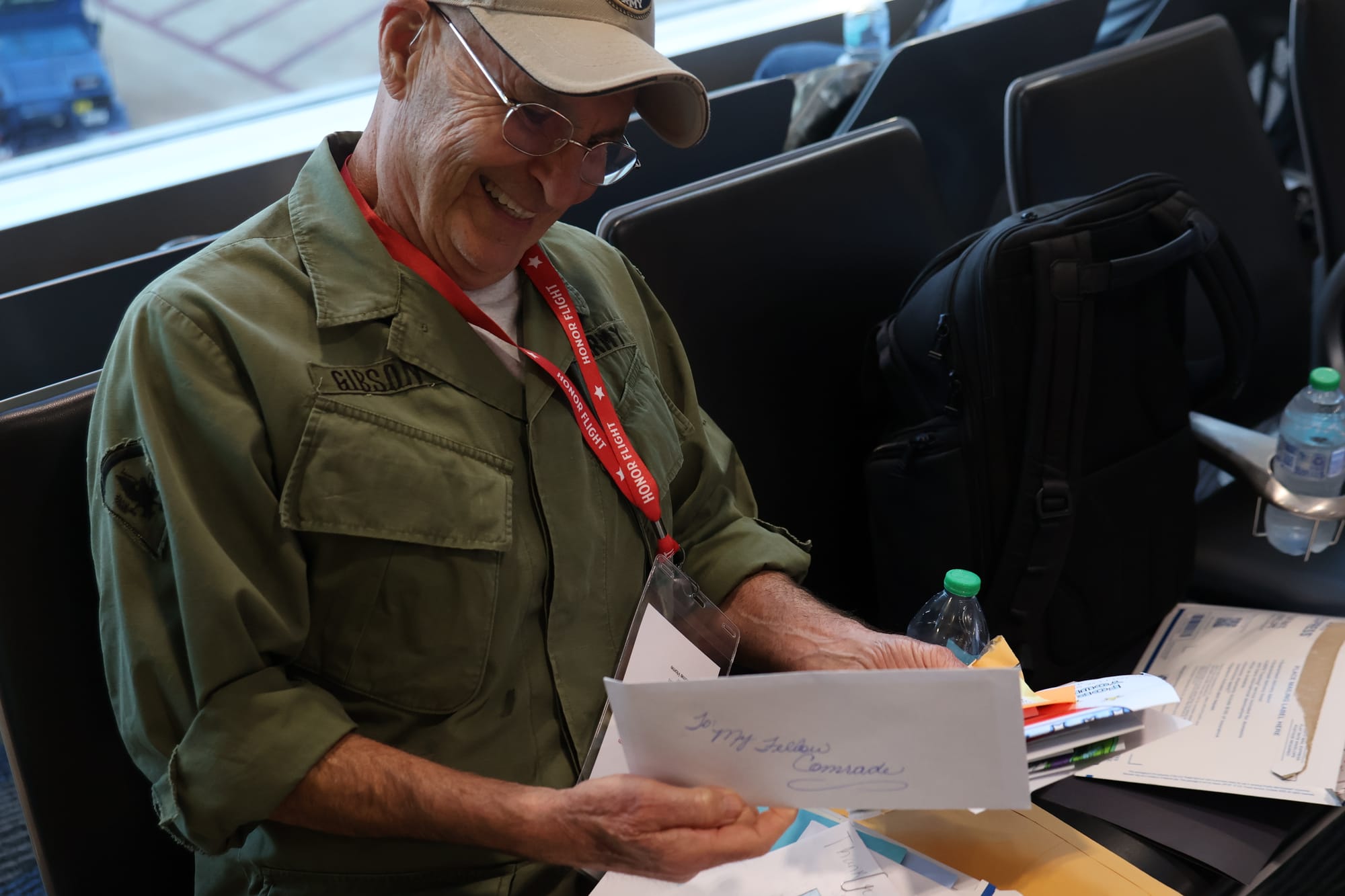
Terry Gibson kept his jacket in a closet for 57 years.
He wore it to Louisville’s airport at five o’clock on the morning of September 29th, the first time it had left the hanger. It is the jacket he wore home from Vietnam, with the combat medic’s patch he had sewn on before he left. “It’s been hanging in the closet for 57 years now,” he said. Had he ever worn it since? “Never. First time.”
There was something else he had avoided for 57 years. He had never visited the Vietnam Veterans Memorial.
“There are three people on that wall whose last words were spoken to me,” Gibson said. As a medic, he explained, the wounded would be flown out and sent home. “That’s the last we ever heard.” But three men didn’t make it out. They were killed on February 23rd, when his small base camp was overrun, and he was with them at the end. “That’s why I haven’t done any of this stuff until now.”
Was he nervous? “Apprehensive,” he said. “But it’ll be good.”
He was one of 84 veterans on an all-expenses-paid honor flight. Over one day, they would tour the memorials they had helped secure, visit the wall, and come home to a crowd of hundreds. I went with them, carrying a question I couldn’t shake.
What can a thank-you do, when it comes fifty years late?
Most of the men on this plane finished serving their country alone. No parade. No one to say thank you. Some had been stripped of their innocence at 18 and left to suffer in silence for the decades that followed.
Terry Gibson’s homecoming, he told me, was nothing. He and the men around him spent about 72 hours getting out of “the jungle of Vietnam,” changed clothes, boarded a plane, and flew straight home. His mother met him at the airport. “I had no welcome home,” he said. “I couldn’t sleep. I stayed in my room for about a week.”
Some got more than silence.
 Shay McAlister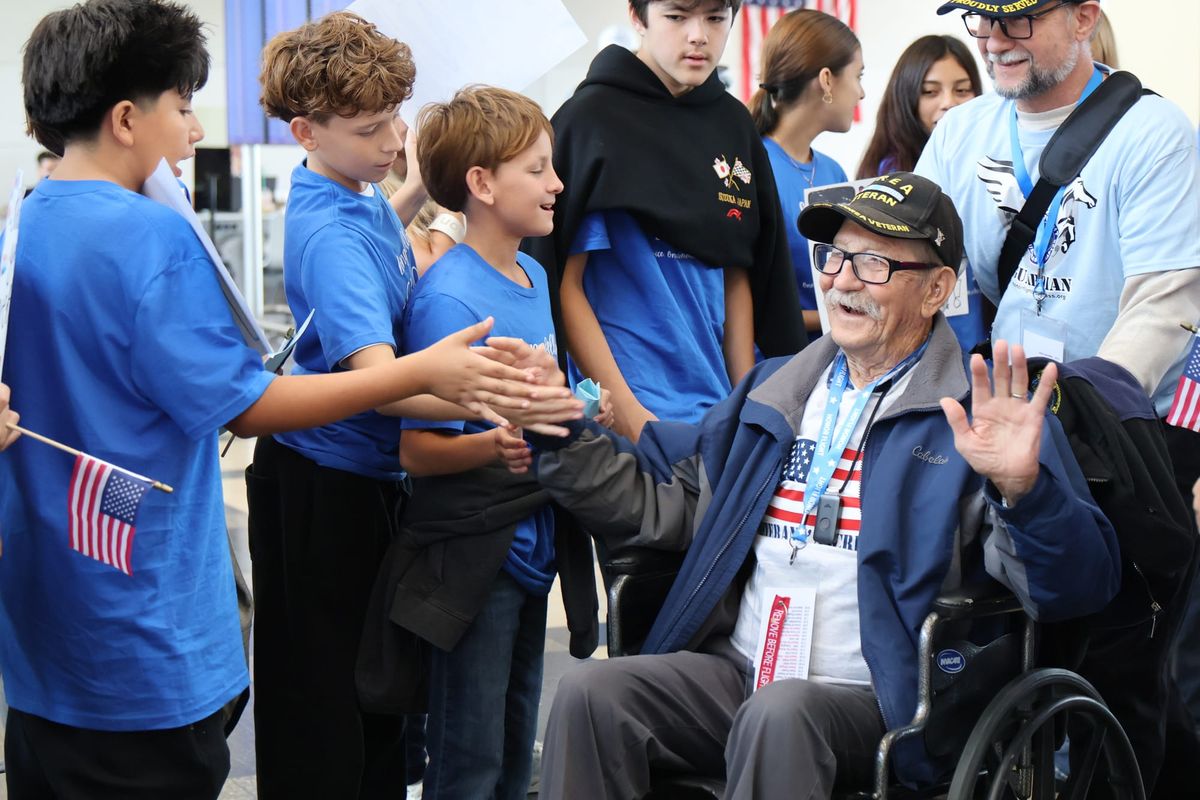
Andy Boyd, an Army veteran, landed at Travis Air Force Base in 1970 and walked into a peace demonstration of 100 or so people. “I hadn’t been on the ground five steps, and some little girl ran up there and spit on me,” he said. “So I said, ‘Welcome home.’” Mike Smith, a Vietnam vet turned pastor, remembers the bus on the back side of the airport. “Protesters were out in front of the airport, not letting us get off, wanting to storm us. And we really wanted to storm them.”
They went on. They raised families. They put it away.
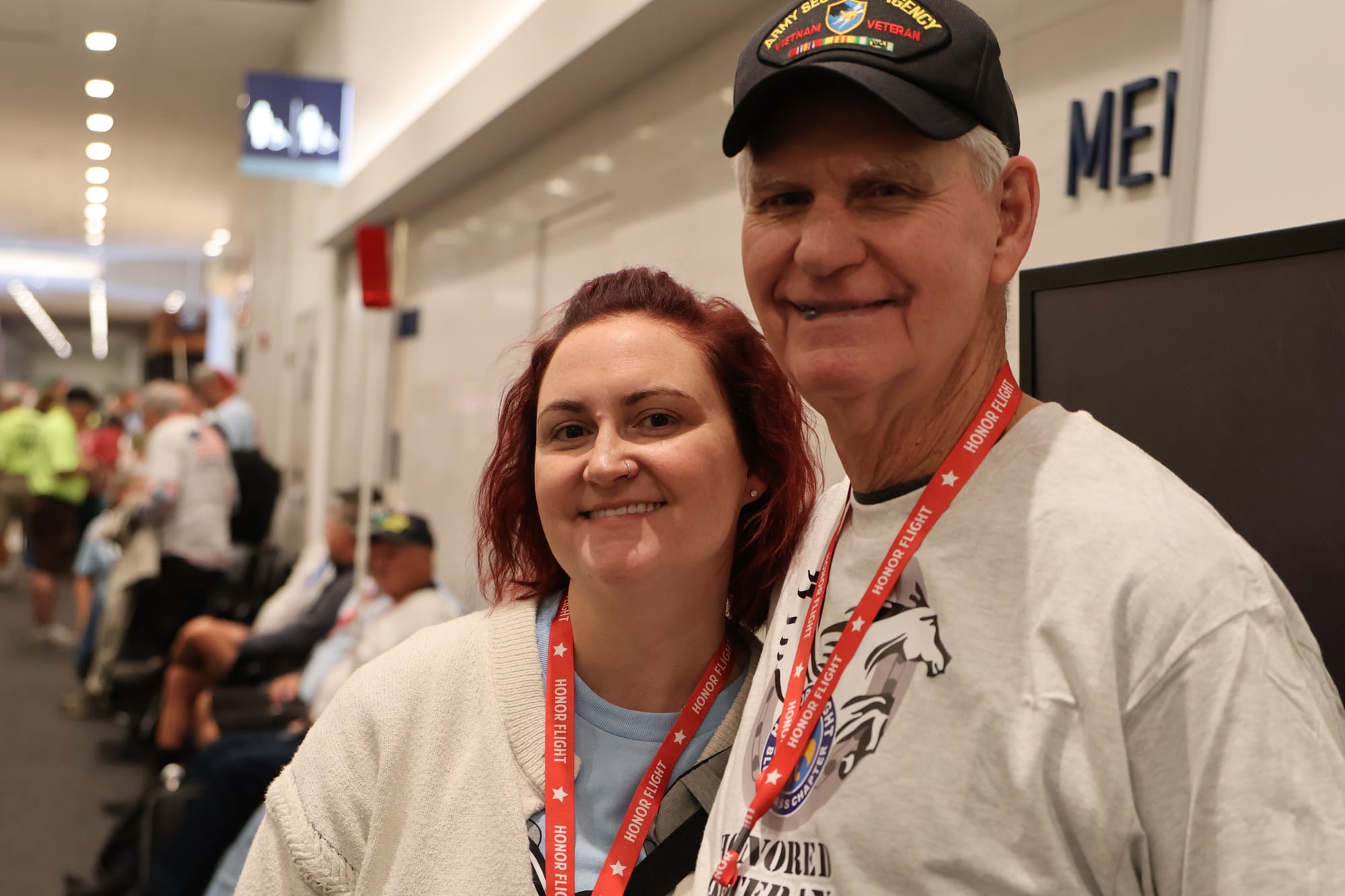
Andy Boyd’s daughter, Trulie Wickham, an ER nurse at UofL, grew up in a house that never talked about it. “I didn’t learn it in history class,” she said, “it was like we didn’t talk about Fight Club at home.” They didn’t eat rice. They didn’t watch war movies. Andy still wakes in the night, he told me, about four nights a week. He once went to apply for benefits and decided against it. “I’m just stubborn enough to say, you know, just suck it up and deal with it.”
Two summers earlier, Trulie had signed him up for this trip without asking. She was too scared to tell him.
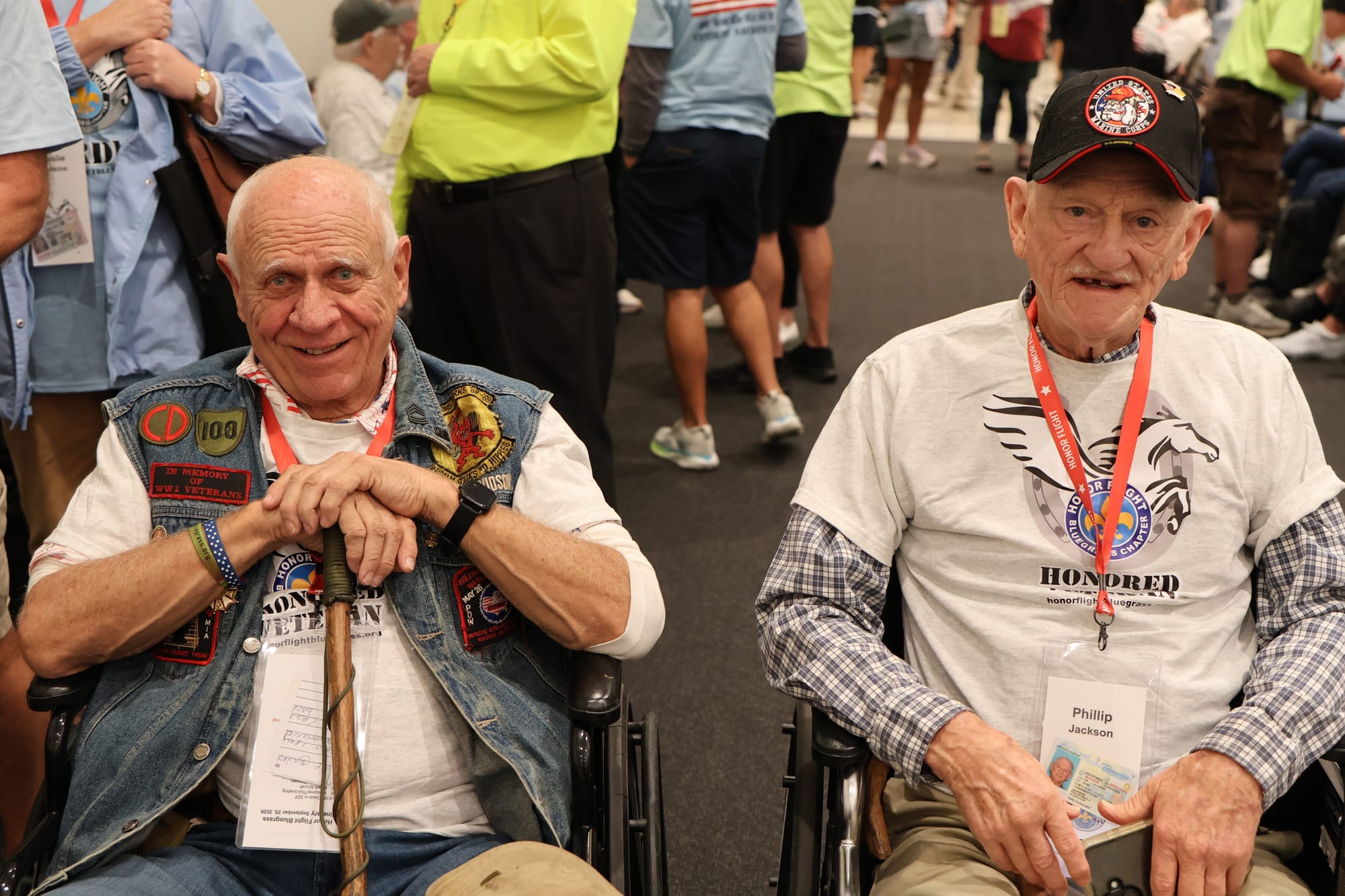
The night before the flight, at a hotel on Louisville’s east side, I met two Marines: Don Harshey of Southern Indiana and Phillip Jackson of Tennessee.
They met in 1967 at El Toro, California, in the same electronics repair unit. They shipped to Vietnam together. When their assignment started winding down, the Marine Corps split them up, and Phillip was ordered to finish his time with another unit. Don stepped in.
“Because we had known each other so long,” Don said, “and I loved him to death, and he didn’t really want to go, and I said, ‘I’ll go.’”
Phillip: “Meant a lot. I hated to leave him, because we’d been, what, four years together, almost. Been through hell and high water. Made it.”
The men laughed about it. Then Phillip put an arm around Don’s shoulders.
They put in for the honor flight for two or three years. Once, Don was offered a spot and turned it down, because they wouldn’t be on the same flight. “I didn’t want to leave him behind,” Don said. What was he most excited about the next day? “Being with him. Being together. Just being together.”
I would follow the two of them all day. They were the thesis of the trip in miniature. The thing wrong with how this country treated its Vietnam veterans was that it left them behind.
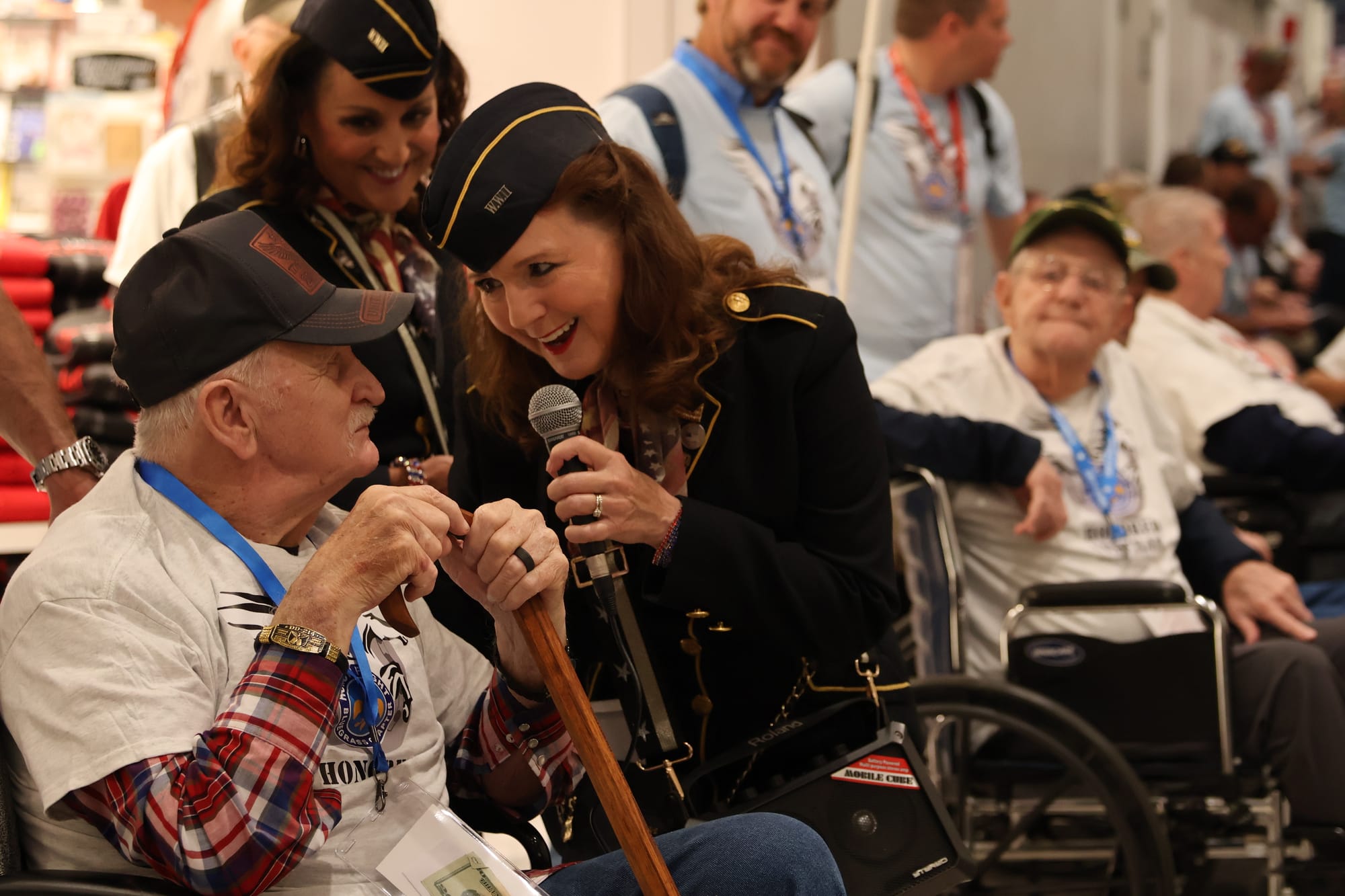
At Louisville's airport, the Ladies for Liberty sang as the veterans lined up to board. The group specializes in hits from the war eras. The veterans often start shy, just listening. Eventually, they start singing along, allowing themselves to break down the first wall of the trip.
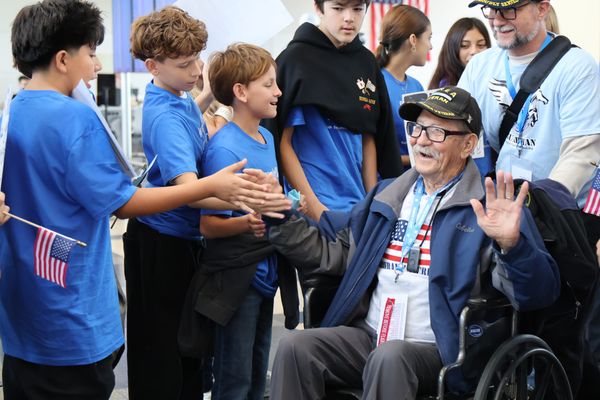
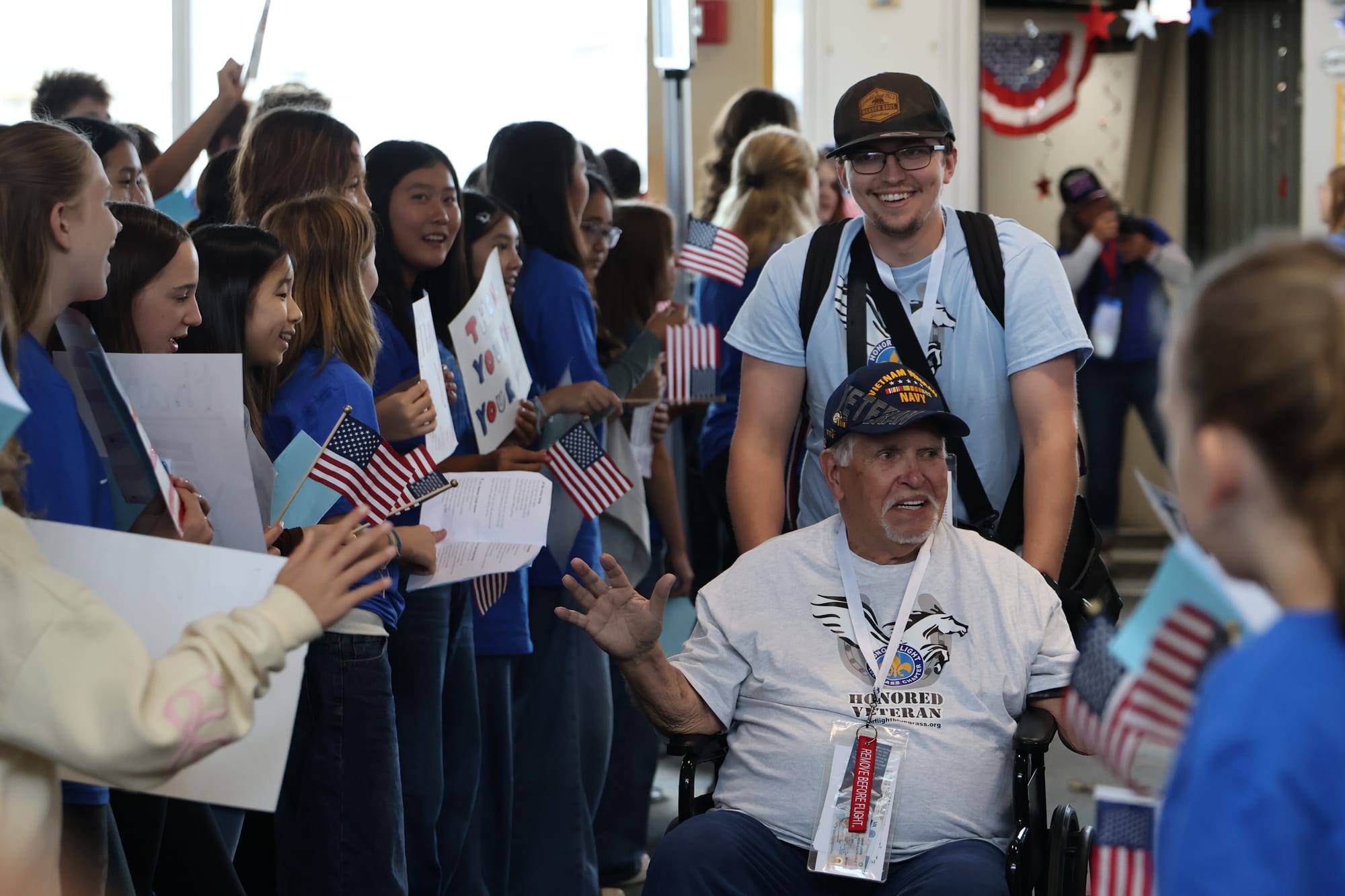
At Reagan National, a local middle school choir was waiting on the other side of the jet bridge, waving flags and thank-you signs.
It surprised the veterans, and the Honor Flight team, who told me they had never experienced it. Other travelers in the terminal cried. Mike Smith handed out high fives as his son Chris pushed him through the crowd of kids. “Words can’t really describe what my heart was doing,” he said. “I’m fist-bumping and just having the time of my life.”
Everywhere we went, a stranger was waiting. At the World War II Memorial, one of them held a welcome sign. Why did she spend her time standing outside, waiting for buses? “My spouse is in the Coast Guard,” she said, “and living here, doing things such as this feels like a responsibility.”
A responsibility. That was the word that kept coming up.
Then, at the fountain, a stranger became family. Larry Smitson, a retired Army staff sergeant, had never really known his father, Private First Class Leland Smitson, who was killed in World War II when Larry was less than a year old. The American flag from Leland’s casket had been in the family for 81 years. Larry’s sister, Joyce Brewer, called me the night before to tell me she wanted to surprise him. “I thought how cool it would be if we could transition that flag over to Larry’s family.”
Honor Flight staffer Stephen Brown, a former Marine, called the group to attention and read Leland’s story: a 31-year-old Kentucky man who met his newborn son on a two-week furlough, went back to Patton’s Third Army, was wounded at Metz and killed in action east of Bitburg, Germany, on March 3, 1945.
Larry’s grandson Mason wheeled him to the front. Mason handed him the folded flag. On the back, a black-and-white photograph caught Larry’s eye. His head dropped over the flag. He closed his eyes. Mason hugged him. Neither said anything.
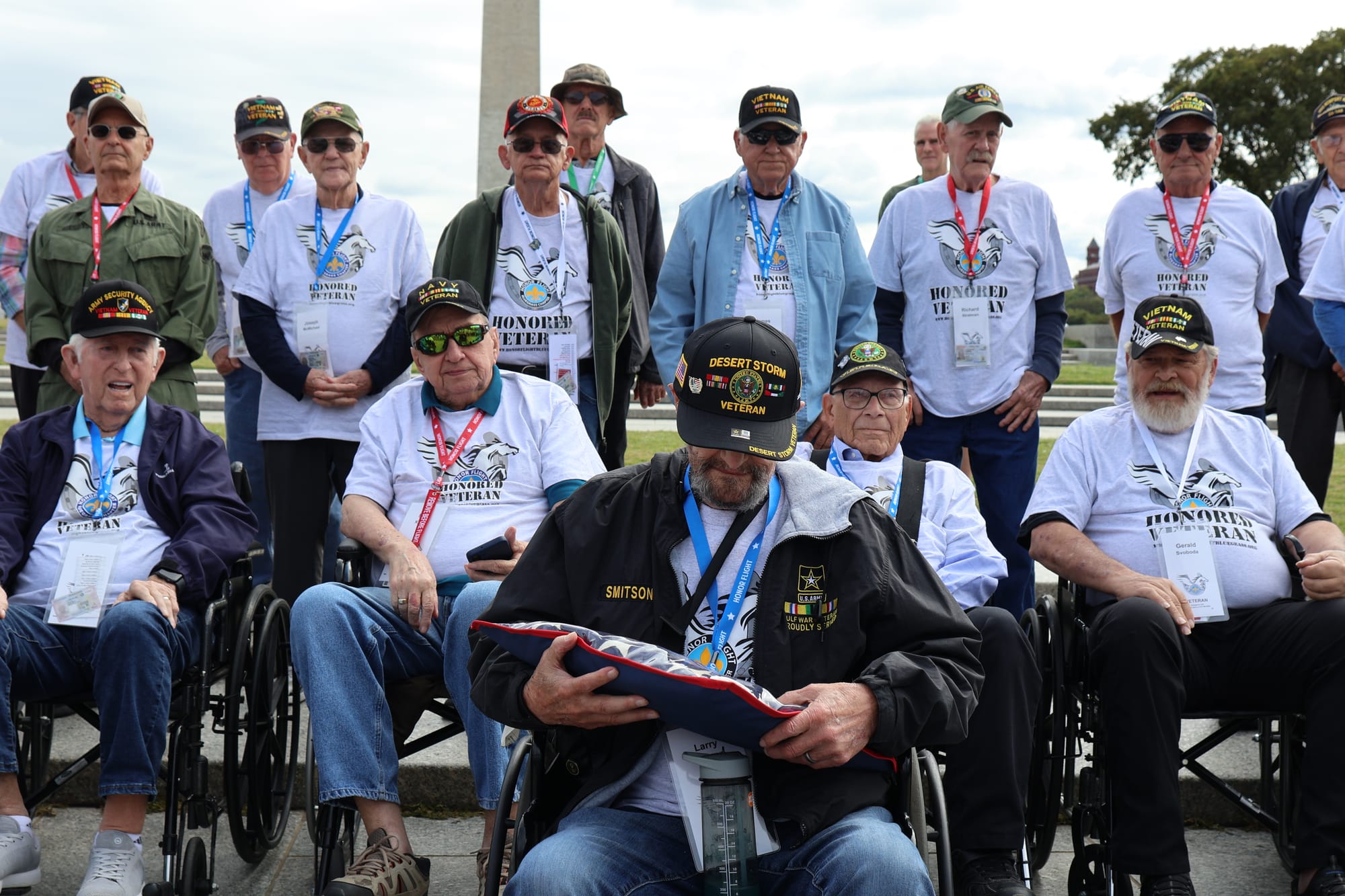
Later, Mason told me what it meant. “Being able to honor the sacrifice he made, and doing it in this memorial, with my grandfather, it's very special."
A man who was left behind in 1945 was being brought forward, 81 years later, by his great-grandson.
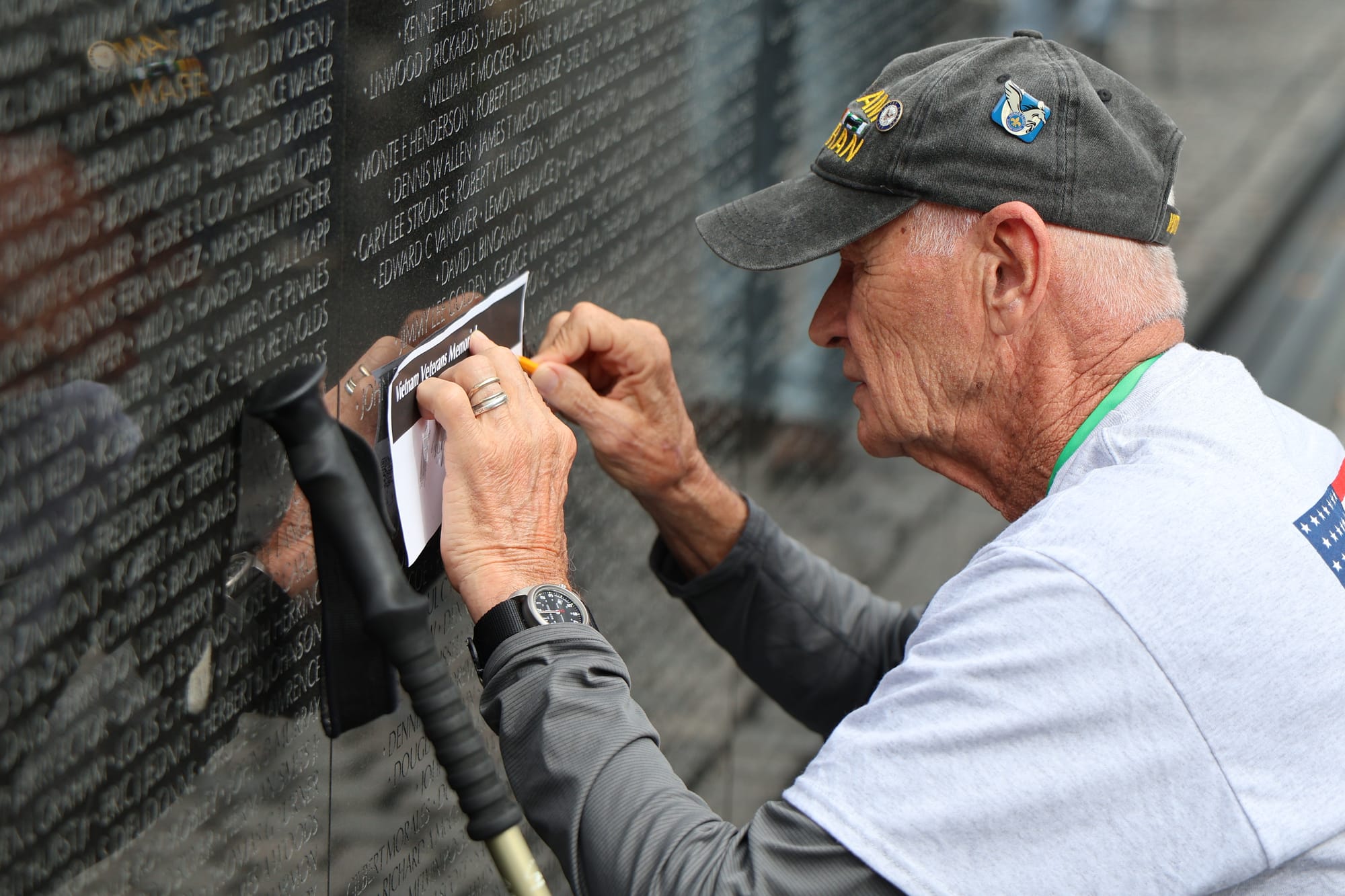
At the Vietnam and Korean War memorials, I walked with Michael Brady, a Bardstown native, who had come with pictures, names and notes. One of the names was a man from New Haven, Kentucky, killed on August 13, 1970. “The day I left Vietnam to come home.”
He had been to the wall once before. “But I didn’t have all the information that I have now. I’m grateful to be able to come back.”
Mike Whitfield, a Navy veteran from Providence, Kentucky, who had shown me film he shot as a 20-year-old sailor the night before, told me he had avoided the wall for years. A boyhood classmate had been killed by a landmine. “I know what to expect,” he said. But for years he wasn't able to face it. On this day he did. After he told me, "I went down, found it, and it was just a calming effect, you know. Full circle."
There was one woman on the flight. Donna Williams, an Air Force nurse at Clark Air Base in the Philippines, had protested the Vietnam War at Eastern Kentucky University a year before she enlisted. “Can you believe that?” she said. At Clark, she was on duty when the first flight of released prisoners of war landed.
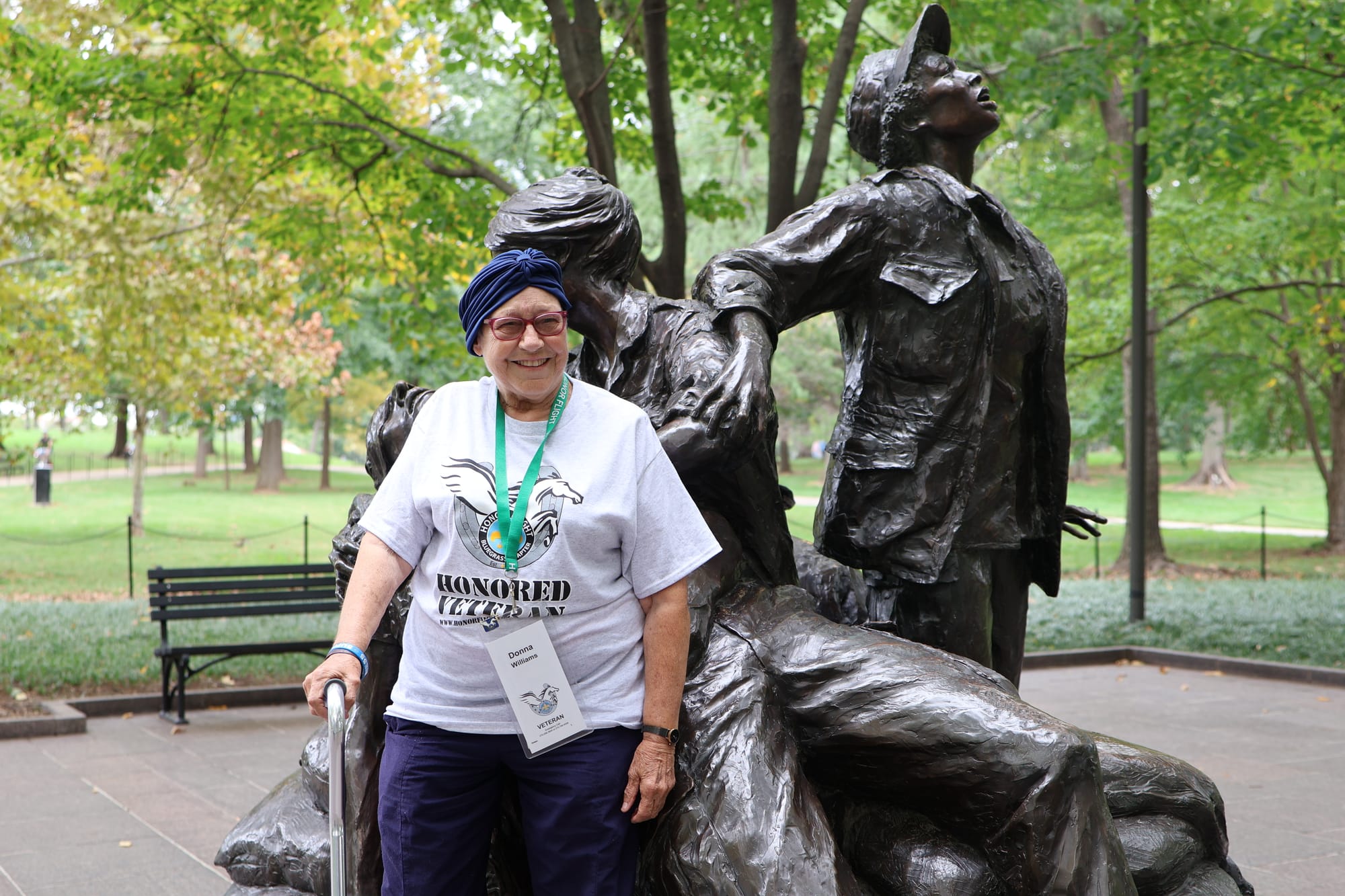
At the Vietnam Women’s Memorial, she asked for help standing from her wheelchair. She placed a hair tie on the monument, a tribute to the nurses who put their hair up and got to work. “Today is one of the highlights of my life that I’ll remember forever. It’s just very overwhelming and very touching," she said, "I just love my country so much. I wish more people loved our country.”
Not far from the wall, we found the FDR Memorial, a quiet place designed intentionally for reflection. Mike Smith and his son Chris took me along as they walked and talked through the day so far.
“This has been excellent,” Mike said. “A lot of interesting things flow through my mind.”
One of them was his complicated relationship with his time in Vietnam. “There are times that I think about it, and then I realize I put it back in the closet a long time ago. Every once in a while it tries to creep out, and what brings it out is when I hear something that the government really botched that caused a lot of deaths.” He received a Bronze Star when he left. “That for me was self-satisfaction.”
And here’s the thing about Mike Smith: you would never know any of that if you didn’t have this particular conversation. The man exudes joy, handing out smiles and fist bumps to anyone who will take them. Before I let him go, I asked what he was most excited about for the rest of the day.
“My wife and I will hug and kiss and dance and just be so happy to see each other,” he said. “We move on with life.”
It was a lesson in finding your happiness in the present, with your people. In small moments that are actually very big.
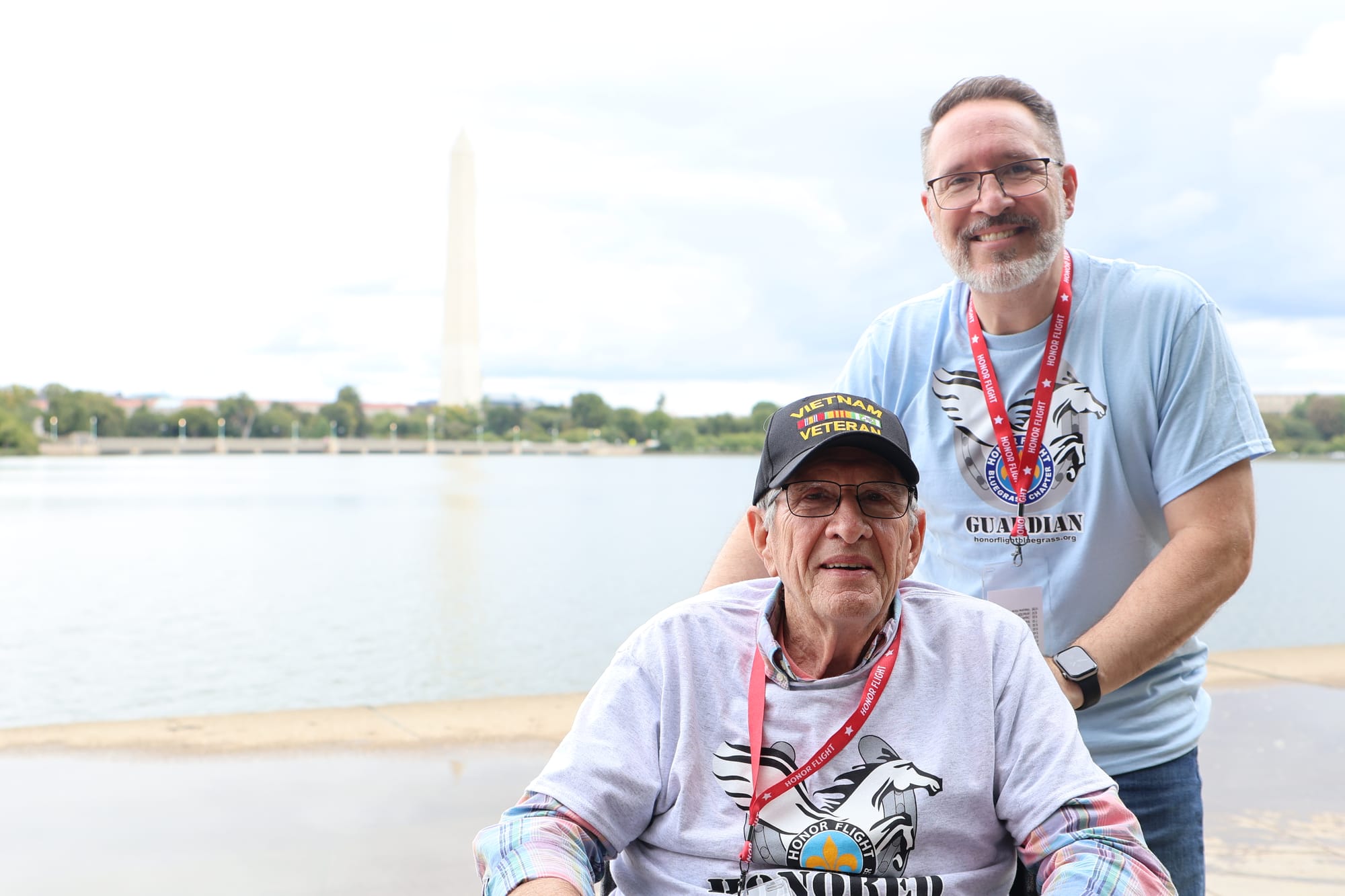
Chris, who grew up around the military, called stepping into the World War II, Korea and Vietnam memorials “something really sobering.” He thought of his grandfather, who served in World War II, and of his father. “I had a feeling it would be emotional,” he said, “but until you get here, you don’t know what it’s like.”
At Arlington, the group stood silent for the changing of the guard at the Tomb of the Unknown Soldier. A bugler played Taps. Phillip Jackson stood beside me. “If that don’t make you soft-hearted and want to cry, nothing will,” he said. He told me about the “processing plant” he saw in Vietnam: trucks piled with black body bags going out the other end of a warehouse in aluminum caskets. “Just think of the heartache that truck was taking with it. I saw that every day.”
I never did get used to hearing the veterans talk about death so plainly. A staff member later told me that when they talk about it at all, it’s often casually- a coping mechanism. On the honor flight, those conversations were welcomed, whatever they looked like.
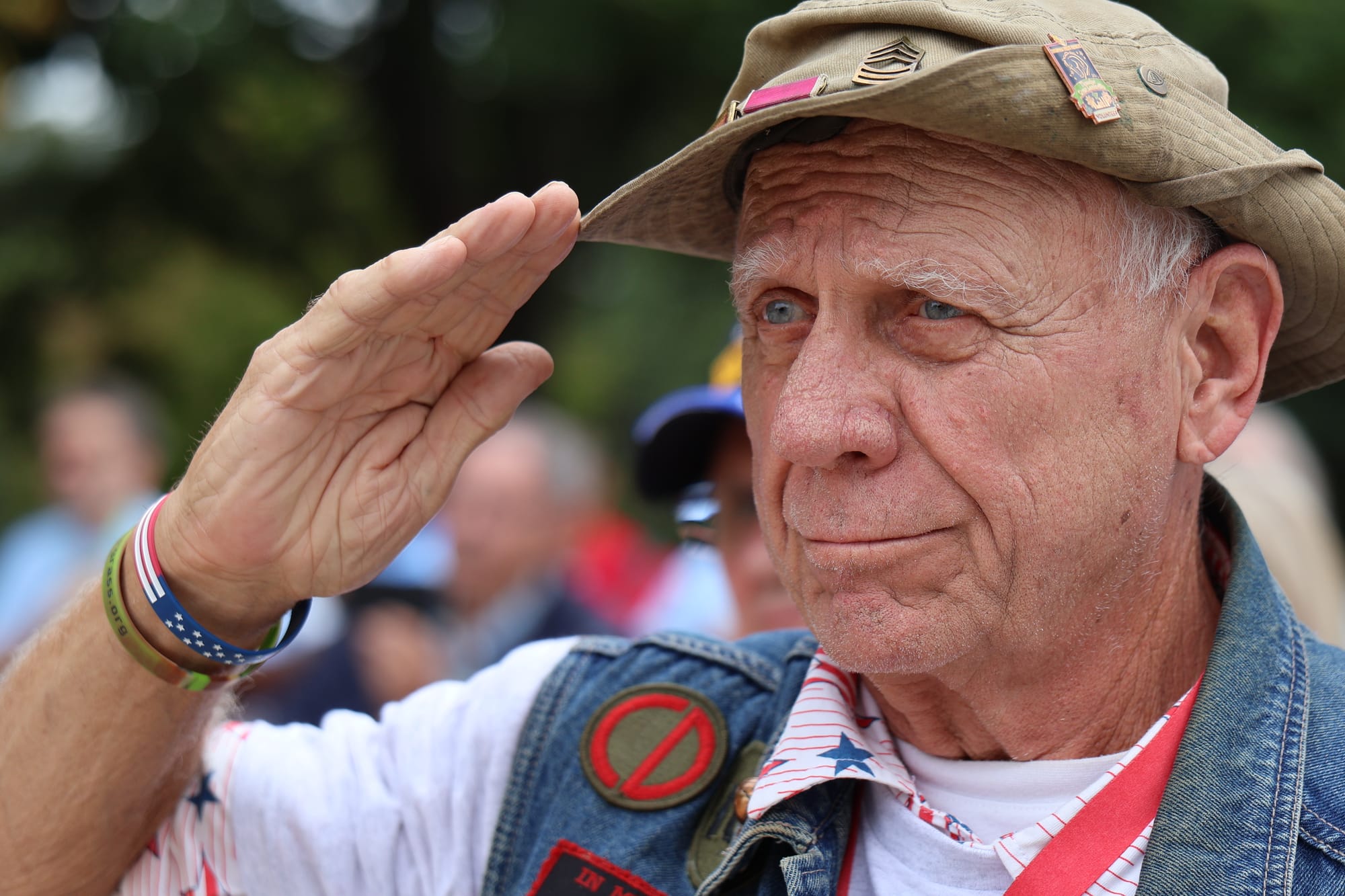
This flight had a special stop before heading back to the airport. We went to the Pentagon to see the 9-11 Memorial. Some of the veterans on this flight had worked in the Pentagon, including Don Harshey. He told me he was brought in right after September 11th to work on an anti-terrorism mission. "They were still doing the crime scene investigation when I got here."
Harshey remembers everyone was on edge and very angry in the first years after the attack. He worked with a team trained to anticipate a future attack before it happened.
"I worked the night shift and had to brief the general that went in to the chief of staff every morning," Harshey explained. "We would contact Mossad or MI 5, and compare information. When we stopped big ones, we were really proud."
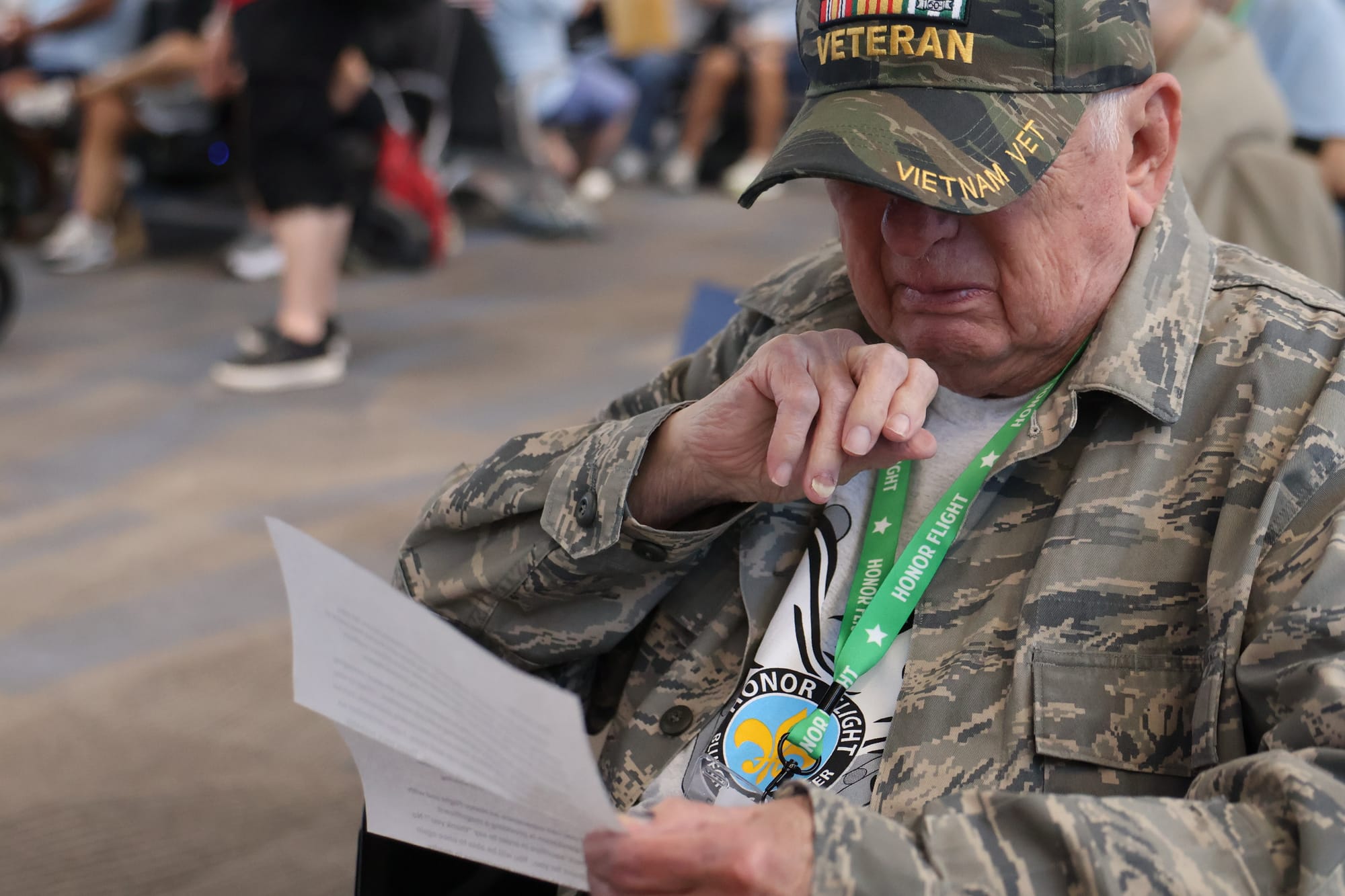
Back at Reagan National, before the flight home, Honor Flight board member Kelli Oakley led the first surprise. In the weeks before the trip, staff had gathered thousands of letters from family, friends and strangers and sealed them into envelopes. “Everybody that served our country had mail call back in the day,” she said, “and it was a highlight because it kept that connection with family and friends back home.” The veterans had no idea. “They will cry. They will laugh. They will be surprised. They will hit every emotion.”
A volunteer read the names with the vets' rank and hometown.
Terry Gibson held his stack. “It’s somewhat, wow, overwhelming,” he said. “I never expected this.” He thought again about the three men whose names he looked for at the wall. “Could I have done more? Was I trained well enough? It was hard. I put everything away for 50-plus years, and this has been good, and I appreciate it. I really do.”
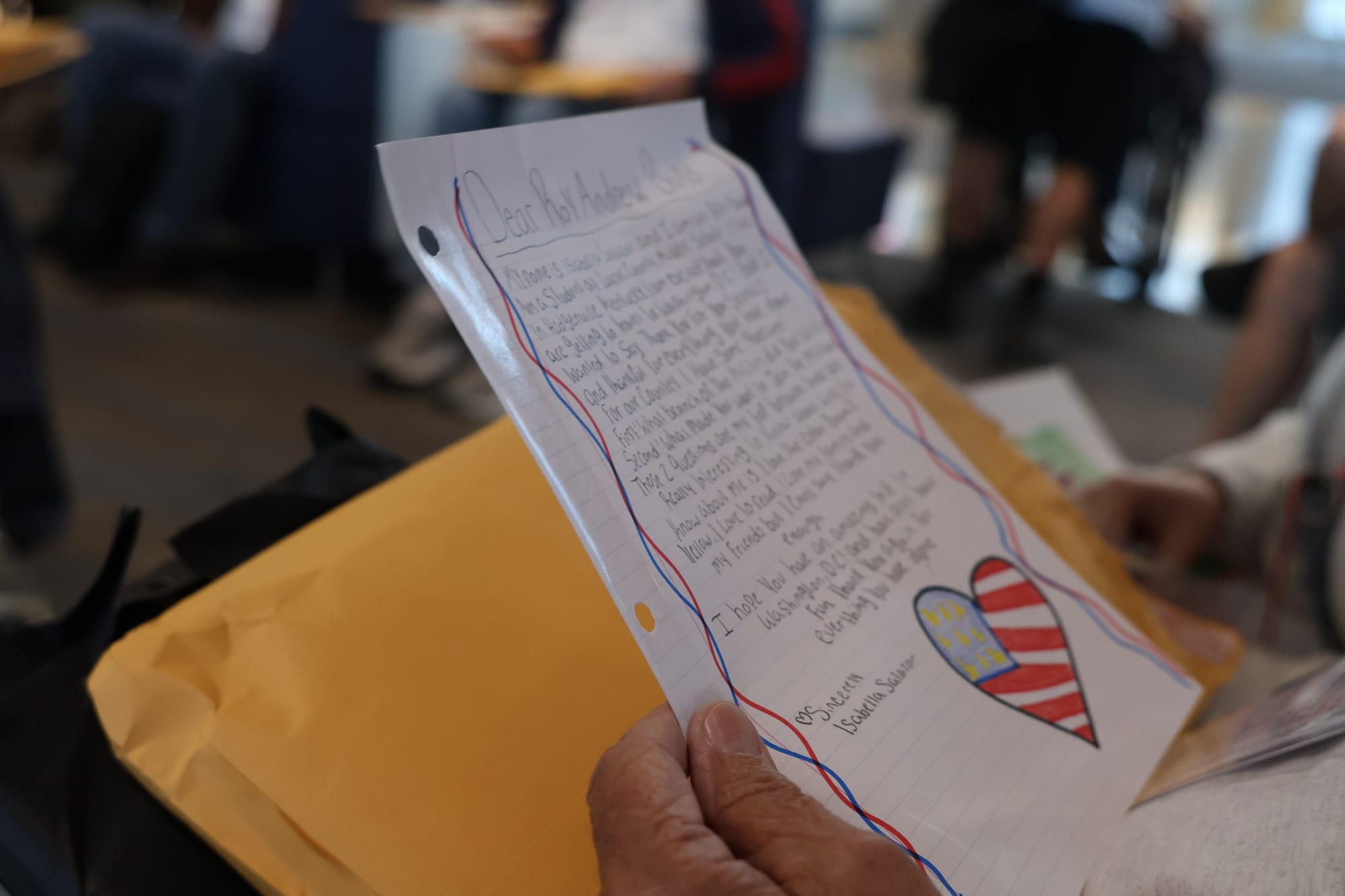
Andy Boyd read a letter from a young student. “Thank you for your service. Me and my family are so thankful for you ensuring our freedom.” Another writer called him a hero and said he was so brave. “Well,” Andy said through tears, “I wasn’t so brave.”
Bob Taylor of Louisville was reading a letter from his sister when I spotted him, quietly weeping. He couldn’t talk about it then. A few days later, he told me what she wrote. “She was so concerned during the actual time of the war when she listened to the news,” he said. His son Ryan, who lives in Florida, sat beside him on the flight home. “He and I text more because of this trip probably than we ever have.”
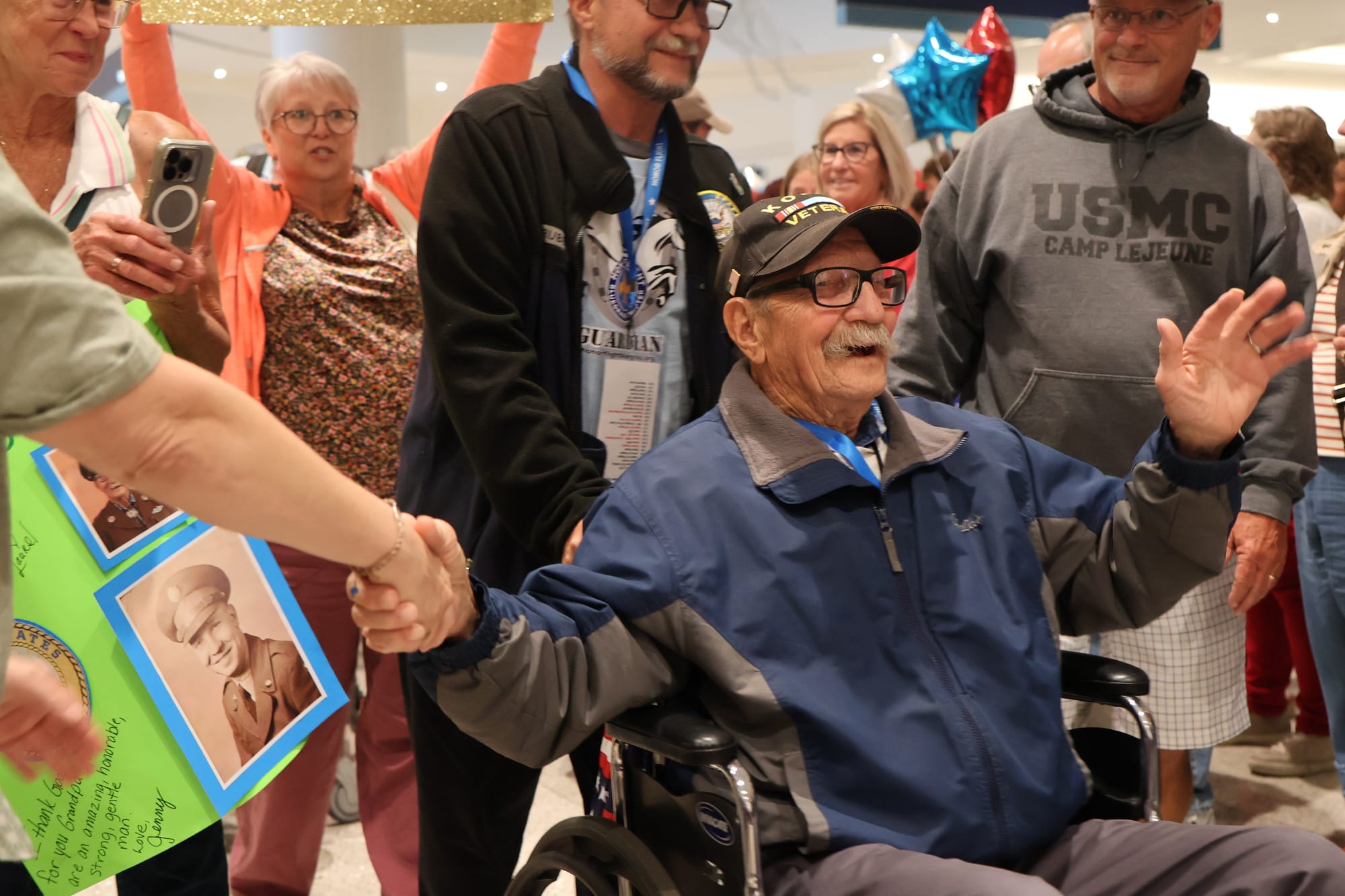
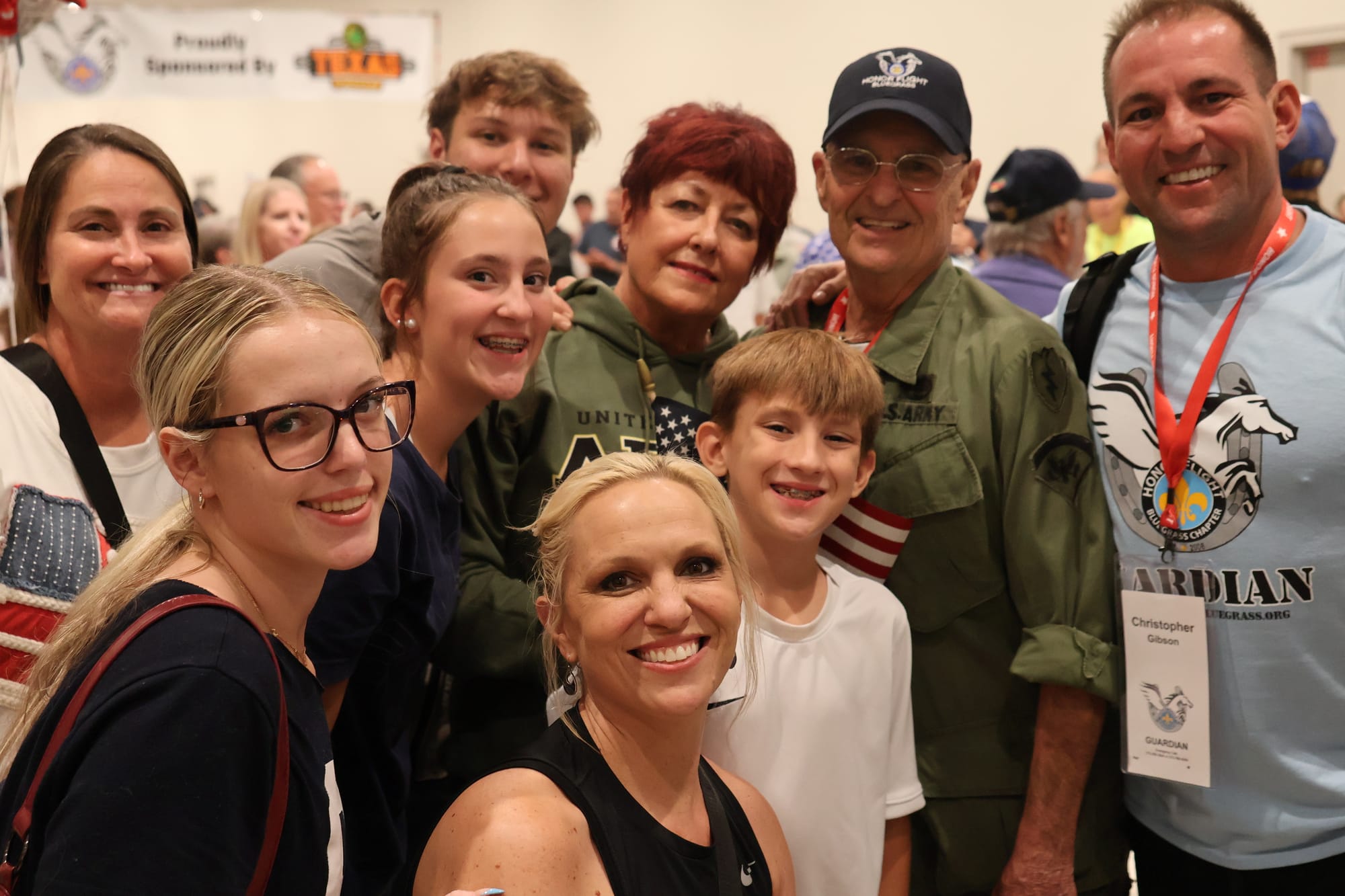
Back at the Louisville airport, the crowd was already building. Hundreds of people, in red, white and blue, waving flags and holding signs, shouting thank you. Families from earlier honor flights stood beside families from this one.
Among them were women who had served in Vietnam. “I want to give the welcome we did not get,” one told me. Susanne Konkle stood beside her father, Daryl Ginn, who had been on the April flight. “It was so emotional and memorable for us as he was welcomed home,” she said, “that we wanted to give it back tonight.”
As the veterans walked through the airport, one after another, their eyes filled with tears. The veterans. The guardians. Mine, too. It was so overdue, and so beautiful.
So, what is a thank-you worth, fifty years late?
It doesn’t give anyone back the years. It doesn’t give Terry Gibson those three men. It doesn’t quiet Andy Boyd’s nights.
But standing in the terminal, watching Gibson reunite with his family, I think the answer is smaller and more important. It tells these men they weren’t left behind.
The concept of an honor flight is simple: show the men and women who earned these memorials just what they earned. Make them feel special. Appreciated. And as if their service meant something. Because it did.
"If you forget the people who gave their life to protect you, you forget what your freedom is all about," Don Harshey told me at the Pentagon.
Freedom isn’t free. It never has been, and it never will be.
About the author- I’m Shay McAlister, founder of Shay Informed. I spent nearly a decade as an investigative reporter in Louisville television before starting this independent platform in August 2025. It's ad-free and funded by subscribers, which means there are no advertisers to please and no clickbait to chase. I have the time to dig into the stories our community deserves: the accountability investigations and the ones like this, which simply deserve to be told well. Your subscription is what makes that possible. Thank you. If you value this work, sign up here!

Subscribers- you can listen to this week's episode wherever you find your podcasts! Follow the instructions below to add it to your library. Email me if you have any questions at all 😊