This week's Supreme Court decisions- and what they mean for Kentuckians

– 6 min read



If your eyes glazed over trying to track the headlines from Washington, here's what actually happened- and why it matters if you live in Kentucky.
"I'm Shay McAlister, and this is Shay Informed: an independent, ad-free platform dedicated to honest journalism with compassion and clarity.
Are you new here? Sign up for the free weekly newsletter or subscribe to support our mission and access behind-the-scenes content, podcasts, and in-depth stories reserved for paid subscribers.
The Supreme Court closed out its 2025-26 term this week with a flurry of major rulings, and not just the procedural kind. Birthright citizenship. Transgender athletes in schools. The privacy of your cellphone's location data. Who the president can fire. What counts as a valid mail-in ballot.
These weren't small cases and the decisions don't all point in the same political direction. So what does it mean for you? Here's a breakdown...
Let's start with the biggest headline. The Supreme Court upheld birthright citizenship- the principle that children born in the United States are automatically U.S. citizens, regardless of their parents' immigration status- and rejected an executive order by President Trump that sought to end that long-standing constitutional principle for children born to many immigrants.
In Trump v. Barbara, the majority held that the Fourteenth Amendment's Citizenship Clause guarantees U.S. citizenship to nearly all individuals born in the United States, regardless of their parents' immigration status. Chief Justice John Roberts wrote the majority opinion.
The ACLU's executive director called it "one of the most important constitutional cases of the past 100 years," noting that Trump had attended oral arguments in person- the first sitting president ever to do so- and still lost. Justices Brett Kavanaugh and Amy Coney Barrett, both Trump appointees, agreed with the decision to strike down the order.
What does this mean for Kentucky? The state has a growing immigrant population, particularly in Louisville and Lexington, where communities from Latin America, East Africa, and Southeast Asia have established deep roots. Had Trump's order been upheld, it would only have applied to babies born after it took effect- but some legal experts had warned that any reasoning upholding the order could potentially be used by a future administration to pursue efforts to strip citizenship from some people. That door is now closed, at least for now.
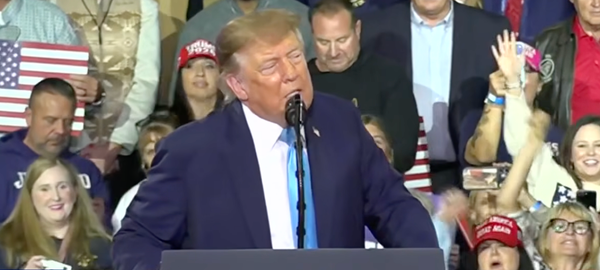
Trump responded on Truth Social, saying the ruling was "too bad for our Country" and calling on Congress to end birthright citizenship through legislation instead.
This one hits closer to home in a direct way. The Supreme Court upheld laws from West Virginia and Idaho that restrict transgender athletes' participation in school sports, ruling that under Title IX and the Constitution's Equal Protection Clause, schools can base eligibility for women's and girls' sports teams on biological sex.
Here's the Kentucky connection: Kentucky already has a similar law in place, passed in 2022. "I fundamentally view this as a victory for truth. It was a victory for the rule of law, and certainly a victory for female athletes," David Walls, executive director of The Family Foundation, said.
Walls was at the Supreme Court in January, for the "Save Women's Sports" rally. He said this was a decision he was anxiously waiting for. "We fundamentally believe that the law should be aligned with what's what's true, and there are distinctions between men and women and boys and girls, and it's of fundamental importance that we, that we recognize those, and obviously the sports is front and center," he said.
But the ruling has nuances worth noting. The majority opinion, written by Justice Kavanaugh, is a narrow one. The Court held that states may exclude transgender girls from girls' sports teams- not that they must. The decision removes a constitutional obstacle to the bans; it does not impose them on states that have chosen not to discriminate against transgender athletes.
The Court also declined to settle the underlying science. It described the question of whether transgender athletes who have taken puberty blockers or hormones have any competitive advantage as "the subject of ongoing medical and scientific debate" and "not settled" at this time.
Advocates for transgender youth were disappointed, but not surprised.
Chris Hartman with the Fairness Campaign in Louisville said, "Unfortunately, it's nothing new for transgender kids and their families who have had to deal with now far worse attacks on their safety, their livelihood, on where they are able to call home and be able to live their full and authentic lives."
Hartman said while the ruling puts weight behind the discrimination that was already passed at a local level, it went short of ruling on the 'big picture'- a win for his team.
"Given how conservative the court is, as narrow ruling as possible was the best case scenario," Hartman said.
This one flew under the radar but could matter for Kentuckians who've ever been near a crime scene, a protest, or anywhere else law enforcement might be curious about.
The Supreme Court ruled that when law enforcement used a "geofence warrant"- a warrant that instructed Google to provide location data for cellphone users who were near a particular place during a specific time period- they conducted a "search" for purposes of the Fourth Amendment.
To explain what a geofence warrant is: imagine police don't have a suspect after a robbery. They can draw a virtual perimeter around the crime scene and demand that Google hand over the location data of every phone that was in that area at that time. Then they narrow it down. In the case before the Court, officers narrowed down device owners to a specific suspect list without criteria set by an independent magistrate- pulling location data of 16 people who were never cited as suspects, including trips to their homes, schools, and a hospital, before narrowing to three.
Justice Elena Kagan, writing for the majority, said that location data "is the automatic price of conventional cell-phone usage"- you don't really choose to give it to Google, it just happens- and that giving that data to a company doesn't mean you've surrendered your privacy rights to the government.
The case was sent back to a lower court to determine whether the specific warrant met Fourth Amendment standards, so Chatrie's conviction hasn't been automatically overturned. But the ruling sets a significant precedent going forward. For Kentucky law enforcement agencies that have used or considered geofence warrants- and federal investigators working cases here- this means the bar just got higher.
This is the most abstract ruling of the bunch, but it has the most sweeping long-term implications.
The Supreme Court overturned a 91-year-old precedent and gave the president significantly greater authority to remove leaders of independent federal agencies, including the Federal Trade Commission. The 6-3 ruling found that Trump's firing of FTC Commissioner Rebecca Kelly Slaughter without cause was lawful.
The FTC is the agency that investigates scams, takes on anticompetitive business practices, enforces consumer privacy rules, and pursues major antitrust cases. The ruling risks "turning independent consumer protection agencies into political pawns," said Emily Peterson-Cassin of the Consumer Federation of America. "When the experts charged with policing fraud, protecting competition, and standing up to powerful corporations can be removed at will, consumers lose an important safeguard against abuse."
The ruling could have implications well beyond the FTC, including agencies such as the Federal Energy Regulatory Commission, Consumer Product Safety Commission, Nuclear Regulatory Commission, and Merit Systems Protection Board- all of which had historically operated with some insulation from White House influence.
In the same breath, the Court drew a firm line at the Federal Reserve, ruling 5-4 that Trump could not fire Fed Governor Lisa Cook while her legal challenge plays out. Economists widely see the Fed's independence as critical to keeping interest rates and inflation from becoming political football- a concern that would affect every Kentucky family with a mortgage, car payment, or credit card.
Justice Sotomayor warned in dissent that the Slaughter ruling means bipartisan commissions can be gutted simply by firing all members of the opposing party. "Just look at the FTC today," she wrote.
With midterms coming in November, this one matters at the ballot box. The Supreme Court ruled in a surprising 5-4 decision that states can count mail-in ballots that arrive after Election Day, as long as they are properly postmarked by Election Day.
Kentucky requires absentee ballots to be received by Election Day- so this ruling doesn't change anything in the commonwealth right now. But it does prevent a Republican attempt to force all states to adopt that stricter rule, preserving the right of other states to have grace periods.
The ruling crossed ideological lines, with conservatives Barrett and Chief Justice Roberts joining the three liberal justices in the majority. Justice Barrett wrote that federal law sets the day voters must make their choice but says nothing about when ballots must be physically received.
Trump called it a "tremendous loss" and urged Congress to pass the SAVE America Act, which would impose stricter requirements for mail voting nationally. That fight is now moving to Capitol Hill.
It was a consequential term, and the decisions don't all point in the same political direction- which is itself worth noting. Birthright citizenship survived. The Federal Reserve's independence held. Your phone's location data got stronger constitutional protection. At the same time, transgender girls in Kentucky school sports face a court-validated ban, the federal agencies that protect consumers and workers have less structural independence than they did a week ago, and the presidency is more powerful than it's been in nearly a century.
Like what you see? Learn more about Shay Informed here! This is honest journalism with compassion and clarity.