Superintendent breaks his silence on the Gaither settlement- lays out the legal risks

– 6 min read


Dr. Joshua Matthews has a lot he says he can't talk about. This morning, he tried to explain what he can.
"I'm Shay McAlister, and this is Shay Informed: an independent, ad-free platform dedicated to honest journalism with compassion and clarity.
Are you new here? Sign up for the free weekly newsletter or subscribe to support our mission and access behind-the-scenes content, podcasts, and in-depth stories reserved for paid subscribers.
In a letter sent to the Shelby County community, the superintendent addressed- for the first time at length- why the district settled with former Martha Layne Collins basketball coach Chris Gaither rather than letting his case go to a tribunal. It's a question I've been asked repeatedly since reporting on the settlement earlier this month, and it's one the district has mostly declined to answer until now.
The timing isn't an accident. Just three days ago, I reported that Kentucky State Police confirmed an open, active criminal investigation into Gaither- one that's been running since January, separate entirely from the district's own personnel process. Today's letter doesn't mention KSP by name. But it lands in the middle of a community trying to reconcile a settlement that paid Gaither nearly $43,000 to resign, with the knowledge that state police now consider him worth investigating.
 Shay McAlister
The superintendent's central argument is about certainty. A settlement, he writes, was "the only way for the District to guarantee the immediate and permanent separation from the certified employee." A tribunal, by contrast, carries real risk: if the three-member panel overturns a superintendent's termination decision, the employee is reinstated- full stop.
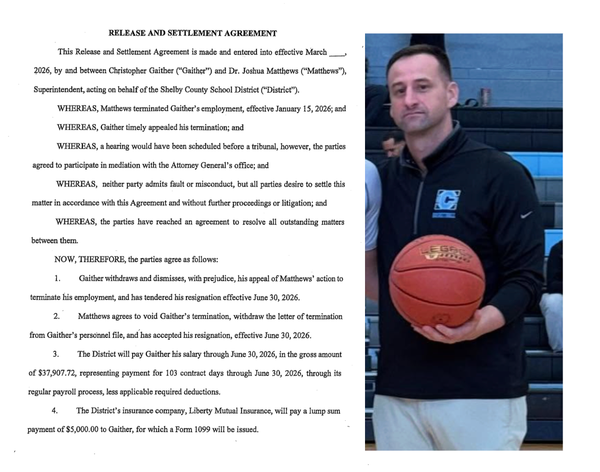
That's not a hypothetical Matthews invented for this letter. Under Kentucky law, when a certified employee appeals a termination, the case goes before a tribunal of three people from outside the district, appointed through the Attorney General's office. Gaither exercised that right in January. According to the settlement agreement I obtained last week, the hearing never happened- the parties went to mediation instead, and that mediation produced the deal that closed the case.
Matthews also points to cost. The district or its insurer covers the expense of a tribunal, on top of legal fees. That tracks with what the settlement itself shows: Gaither's $5,000 lump-sum payment came from the district's insurer, Liberty Mutual, while his $37,907.72 salary payout ran through regular district payroll. A tribunal- and then any possible legal action that came after it- would run the district a tab much higher.
Then there's the Education Professional Standards Board, known as EPSB. Matthews writes that state investigations- like the one the Education Professional Standards Board could pursue against a teaching certificate- are typically held in abeyance until a tribunal wraps up, and that a tribunal's outcome can still be appealed to circuit court afterward, with the employee retaining certification throughout. By settling instead, Matthews argues, the district "empowers state agencies to proceed with their reviews immediately." The settlement agreement does require that the document and related information be submitted to EPSB, as Kentucky law mandates. I reached out to EPSB about Gaither's status when I reported on the settlement; the agency said it can't comment on pending investigations.
 Shay McAlister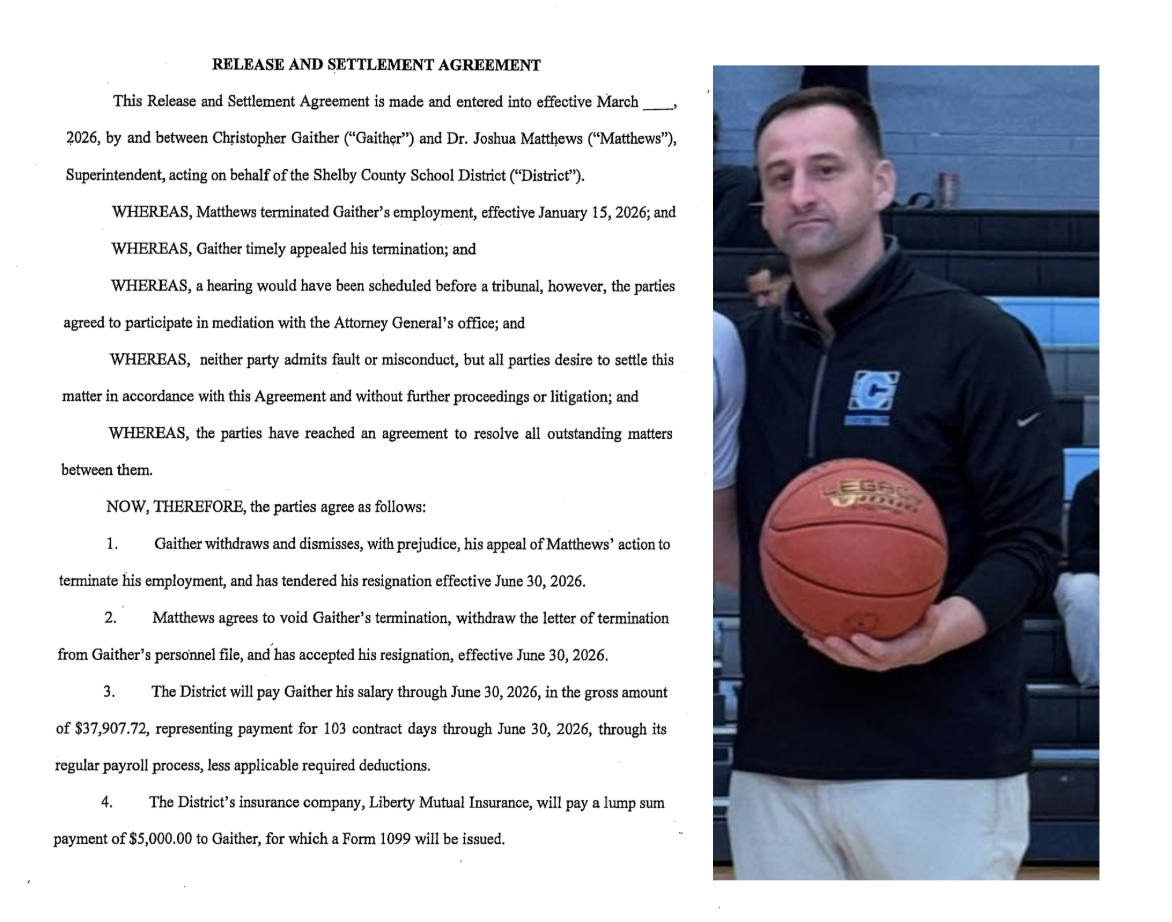
Matthews also frames the settlement as protective- specifically of the people who came forward. He notes that out-of-state witnesses can't be compelled to testify in an administrative hearing, and that even local witnesses are sometimes reluctant. The settlement, he says, included provisions shielding those individuals from disparagement and retaliation.
That detail lines up with what I reported in the settlement itself: a mutual non-disparagement clause barring either side from disparaging comments about Gaither, the superintendent, the board, or district employees- though the clause explicitly doesn't stop anyone from testifying truthfully or cooperating with an investigation.
Matthews closes by drawing a distinction between confidentiality and a non-disclosure agreement, asserting the settlement is neither, since it can be- and has been- obtained through an open records request. He also says mediation is a standard part of the tribunal process, run through the Attorney General's office, and reiterates that nothing has been or will be removed from any personnel file.
That last point is worth sitting with, because it's not quite what the settlement agreement says. As I reported, the document I obtained shows the district agreed to void Gaither's termination and withdraw the termination letter from his personnel file- replacing it with an accepted resignation. Whether "withdraw" amounts to "removal" may be the kind of distinction lawyers can defend, and the public still finds hard to square.
You can read Matthews' statement in full here.
Earlier this week, a member of leadership with direct knowledge of the closed-door meetings called me directly. They told me they were concerned the public was misreading the district's intentions, and wanted a chance to explain- though they were candid that there's only so much they're legally permitted to say on the record. We first spoke on background- meaning nothing they told me could be reported. I then shared the reality of journalism- I can't report on background, I need someone on the record. They agreed, under the condition of anonymity.
Much of what they told me tracks closely with what's in Matthews' letter, but with a few additional layers of detail.
They confirmed that mediation is overseen specifically by the Tribunal Administrative Hearing Judge through the Attorney General's office, and that the AG's office also handles tribunal dismissals and agreement reviews. On the tribunal itself, they were more specific than the superintendent's letter: each panel consists of three people appointed by the Attorney General from outside Shelby County, and the employee can choose whether the hearing is public or private. If the panel sides with the employee, reinstatement comes with back pay.
On the financial picture, they added a detail Matthews' letter didn't include- that even when insurance covers part of a tribunal's cost, claims can drive up the district's future premiums.
They were also more direct about shielding Hayley Weddle- the woman whose public statement launched the investigation into Chris Gaither last December. She's a former Shelby County Schools employee, and the settlement specifically protects any current or former employees from retaliation or disparaging remarks.
Where this source was most insistent was on the personnel file question. "I understand that the settlement is written in legal jargon," they told me, "but we do not remove anything from a personnel file. Our attorneys have advised us not to remove anything from a personnel file." It's the same assurance Matthews makes in his letter- and it runs into the same tension with the word "withdraw" in the settlement document itself.
Matthews' letter explains a legal strategy. It doesn't resolve the tension at the center of this story: a settlement built, by his own account, to let state investigations move forward immediately- arriving the same week the public learned Kentucky State Police had already been investigating Gaither since January, quietly, this whole time.
If you have information relevant to the Kentucky State Police investigation into Chris Gaither, you're encouraged to contact KSP Post 12 in Frankfort at 502-227-2221.
Like what you see? Learn more about Shay Informed here! This is honest journalism with compassion and clarity.